Anthropic Is Not Worth $83 a Share (It Might Be Worth More)
(But also it might be worth less.)
Published: November 20, 2026
Valuation Upfront
Anthropic priced its IPO at $83 a share on November 18. On the ~16.4B shares that exist once every option, RSU and convertible note turns into stock, that's ~$1.36T.
$83 is more than the cash flows support. But this is the more fairly priced of 2026's two trillion-dollar IPOs, and the part of the price I can't explain rests on a bet Anthropic is far better placed to win than SpaceX. Not a buy call. A "less crazy" call.
I get two numbers for what a share is worth:
- ~$18–45 if you value only the revenue Anthropic's signed compute contracts can serve. That's the only forecast the company has put its own money behind.
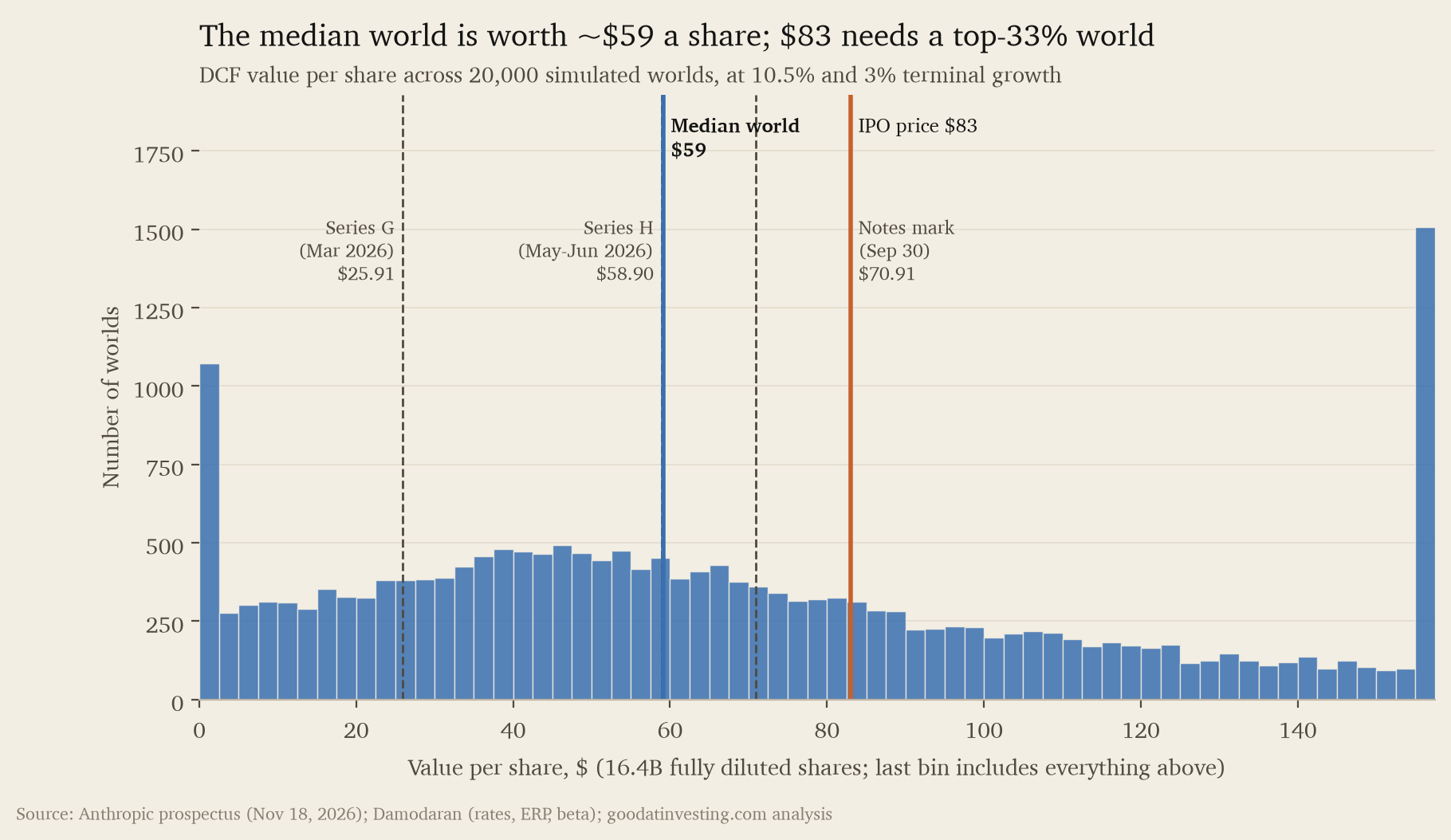
- ~$69 if you average 20,000 simulated futures where Anthropic keeps 30–55% of all AI spending. About a third of those futures are worth $83 or more.
So $83 is 1.2x my generous forecast and 2–5x the company's own contracts. The gap has to be paying for something. In my SpaceX post I called that something a lottery ticket on a $10T breakthrough. Run the same math here and $83 implies a ~2% chance that Anthropic wins it. SpaceX's price implies ~16%. One of these companies trains frontier models. The other rents it the data centers.
Start with the S-1
The $104B loss that isn't a cost
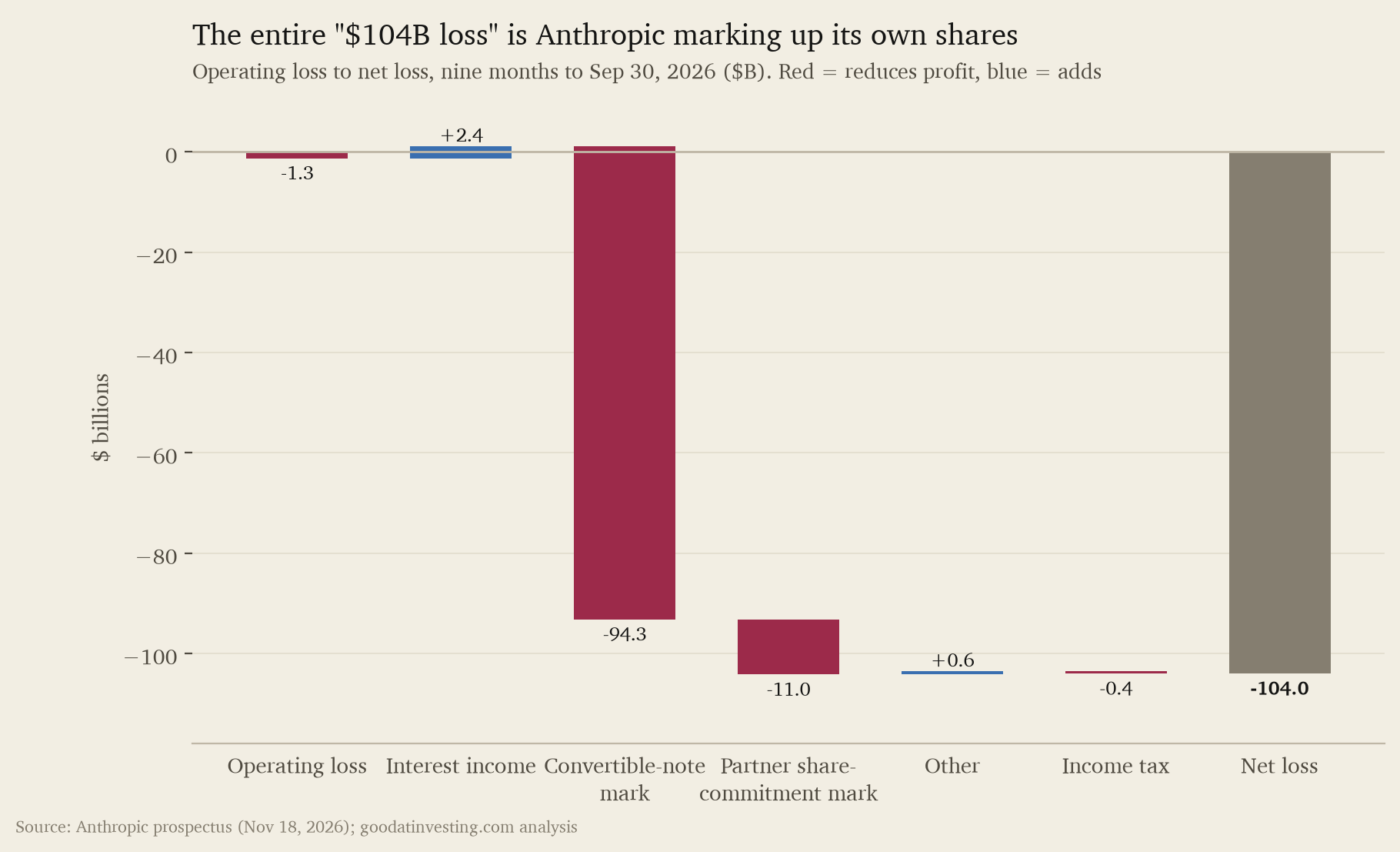
Anthropic lost $104B in the first nine months of 2026, according to the paperwork it filed with the SEC. You can easily ignore that; even Anthropic detractors know that's not a real loss.
Anthropic raised a lot of money through convertible notes, mostly from Amazon: loans that turn into shares later at a set price. Accounting rules make the company re-value those notes every quarter at what they're worth today, a fair-value mark. When Anthropic's valuation rises, the shares the notes will turn into are worth more, so the liability grows, and that growth is booked as a loss. In 9M-2026, the notes accounted for $94.3B of loss and commitments to sell shares to partners another $11.0B. Together that's more than the entire net loss.
So the loss is the company becoming more valuable and owing more of itself to Amazon. The better Anthropic does, the more it "loses." That's real dilution (Amazon ends up owning more of you), but it's not a cost of running the business, and it stops when the notes convert at the IPO.
Real revenue, real margins
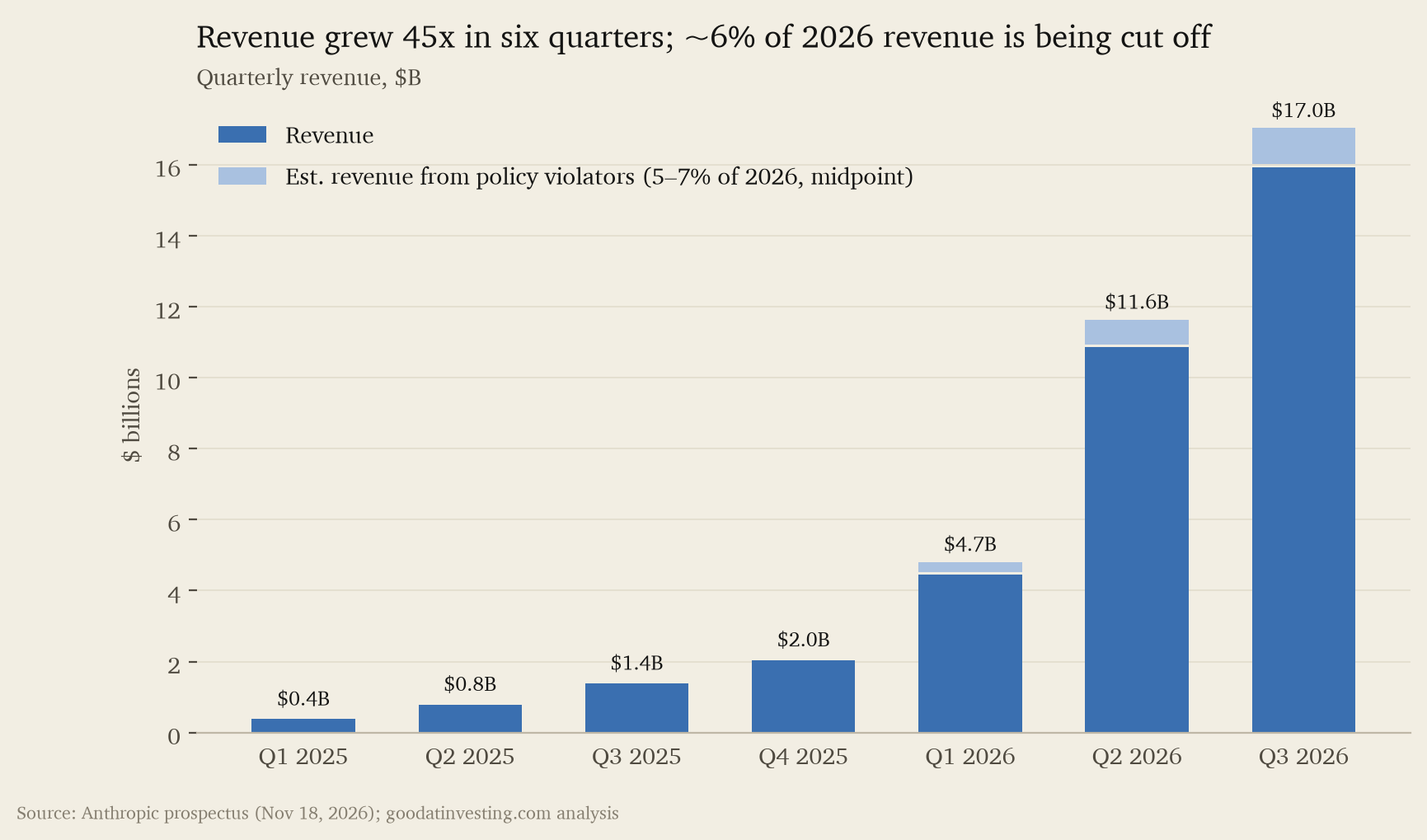
Reported revenue was $33.2B for 9M-2026, and Q3 annualizes to ~$68B. I take ~6% (5–7%) off 2026 revenue for customers Anthropic is cutting off for violating its usage policy, which puts the clean Q3 run-rate at ~$64B. Still a 12x year. Most companies would frame the chart below.
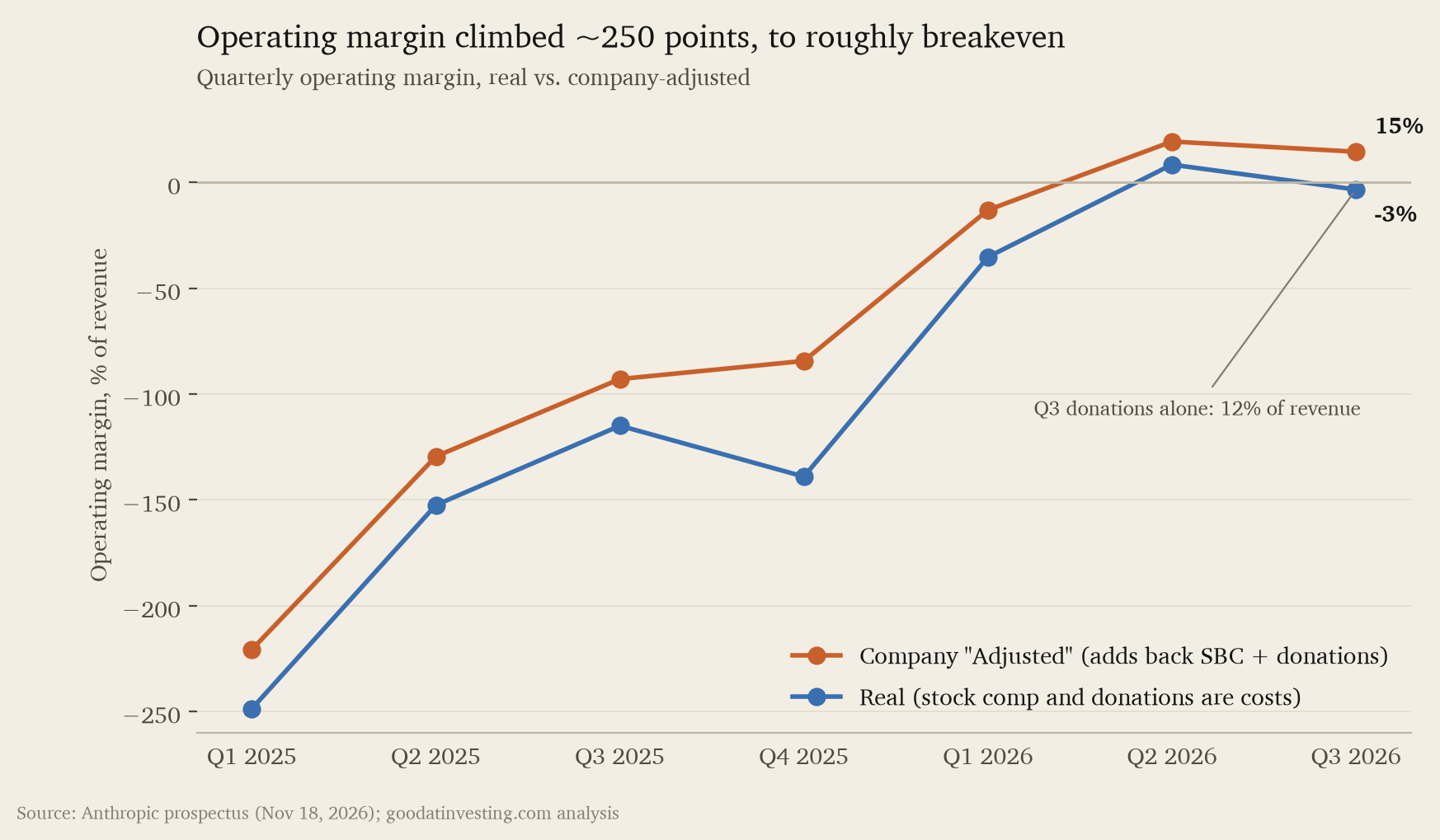
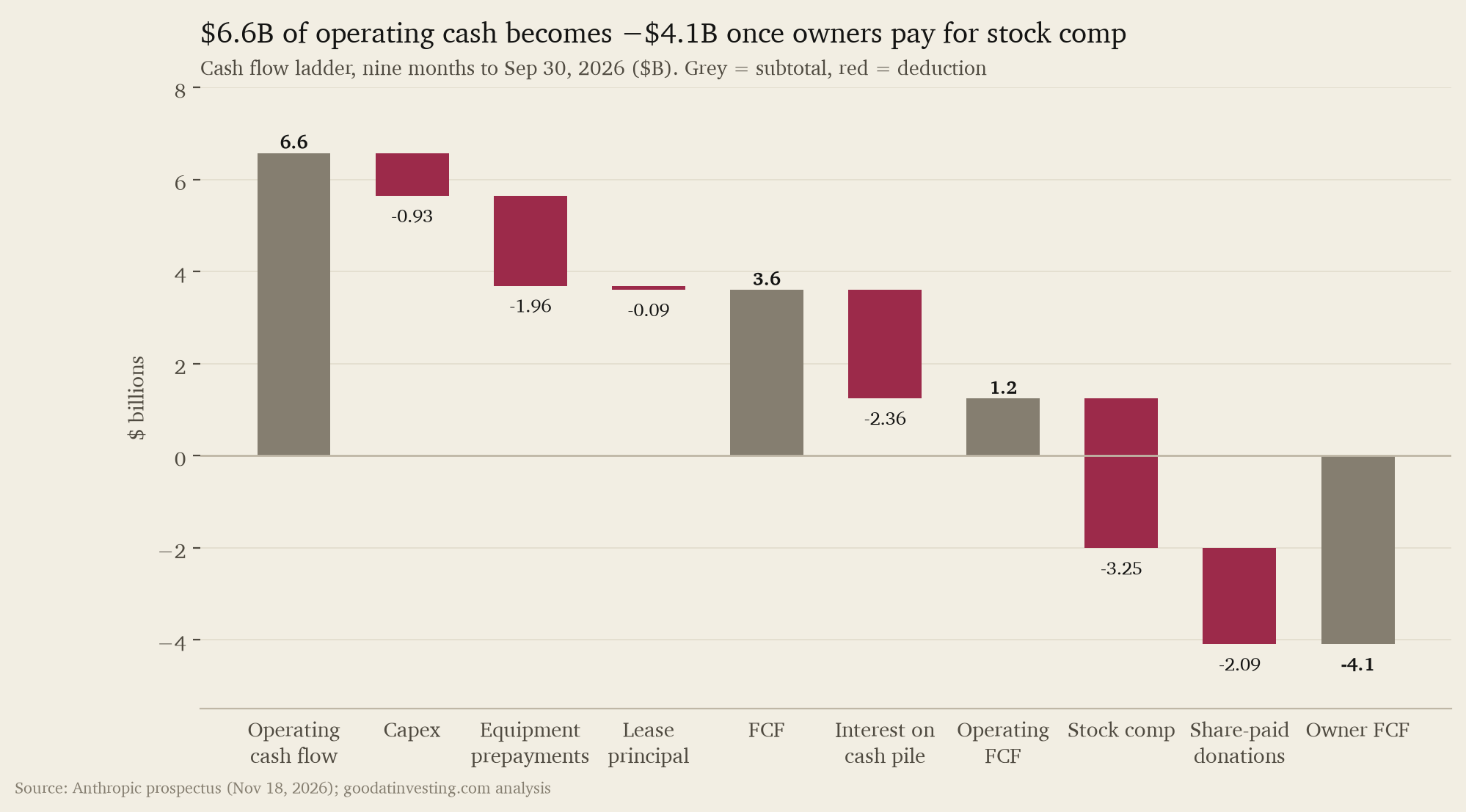
Then there's "Adjusted," the finance word for "if you ignore the bad parts." Like most IPO filings, the S-1 offers an Adjusted operating margin of 15% in Q3. It gets there by adding back stock compensation and donations, which it pays for with shares. Paying people in stock instead of cash doesn't make the cost go away; it moves it from the income statement to your ownership percentage. Count those as costs (and strip out one legal settlement that won't recur) and the real operating margin is −4% for 9M-2026.
Free cash flow tells the same story. FCF (cash from operations minus everything spent on servers, chip prepayments and lease payments) was $3.6B. But $2.4B of that is interest on a $132B pile of investors' cash. All the money raised by Anthropic that they haven't spent is sitting essentially in a money market account earning 4% a year and is one of Anthropic's best-performing products of 2026. Take the interest out and charge stock comp and donations, and owner FCF is −$4.1B. Not a disaster for a company growing 12x. Not a profit either.
Which share count
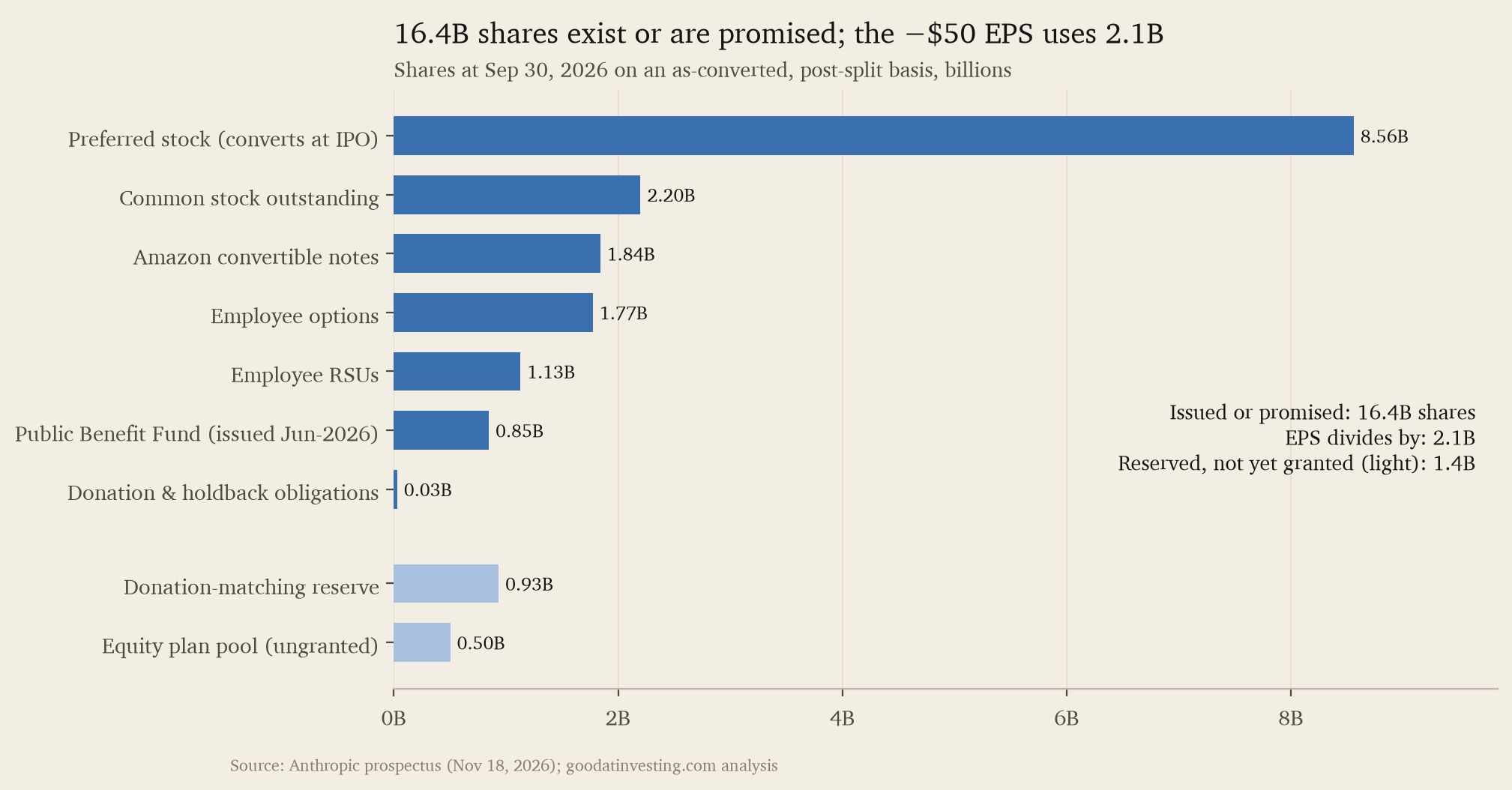
The S-1's loss per share divides by 2.1B shares. Ignore it. At 2.1B shares, $83 looks like a ~$172B company. Once the preferred stock, notes, options and RSUs all become common stock, there are ~16.4B shares, and it's a $1.36T company. That's the denominator for every per-share number here. It already includes ~18% of shares owed to employees and 5.2% to the Public Benefit Fund. More on what those cost later.
How much does a token cost?
Not a lot. Anthropic's margins would make a SaaS company from 2012 blush.
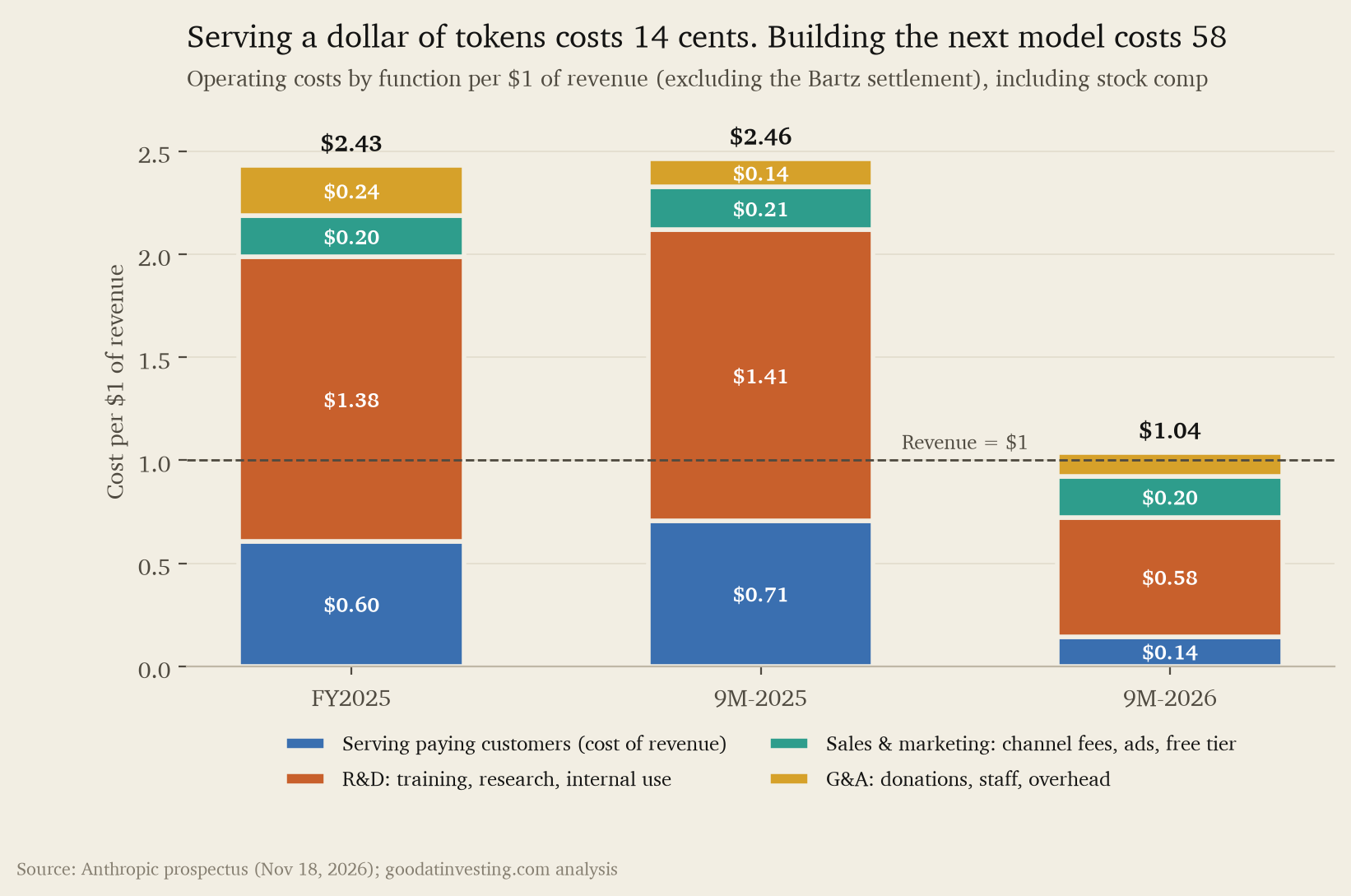
In 2026, cost of revenue (substantially all compute for serving paying customers) was 14.5¢ per dollar of revenue: an ~85% gross margin, up from ~29% a year earlier. Only about a quarter of Anthropic's compute serves paying customers. The rest is training, research, internal use and the free tier. Research and development alone ran 58¢ per revenue dollar.
The S-1 doesn't split subscriptions from the API, but it gives enough to bound it. Three numbers for 9M-2026: $26.3B of API revenue, $6.9B of subscriptions, and $4.8B of cost of revenue to serve both.
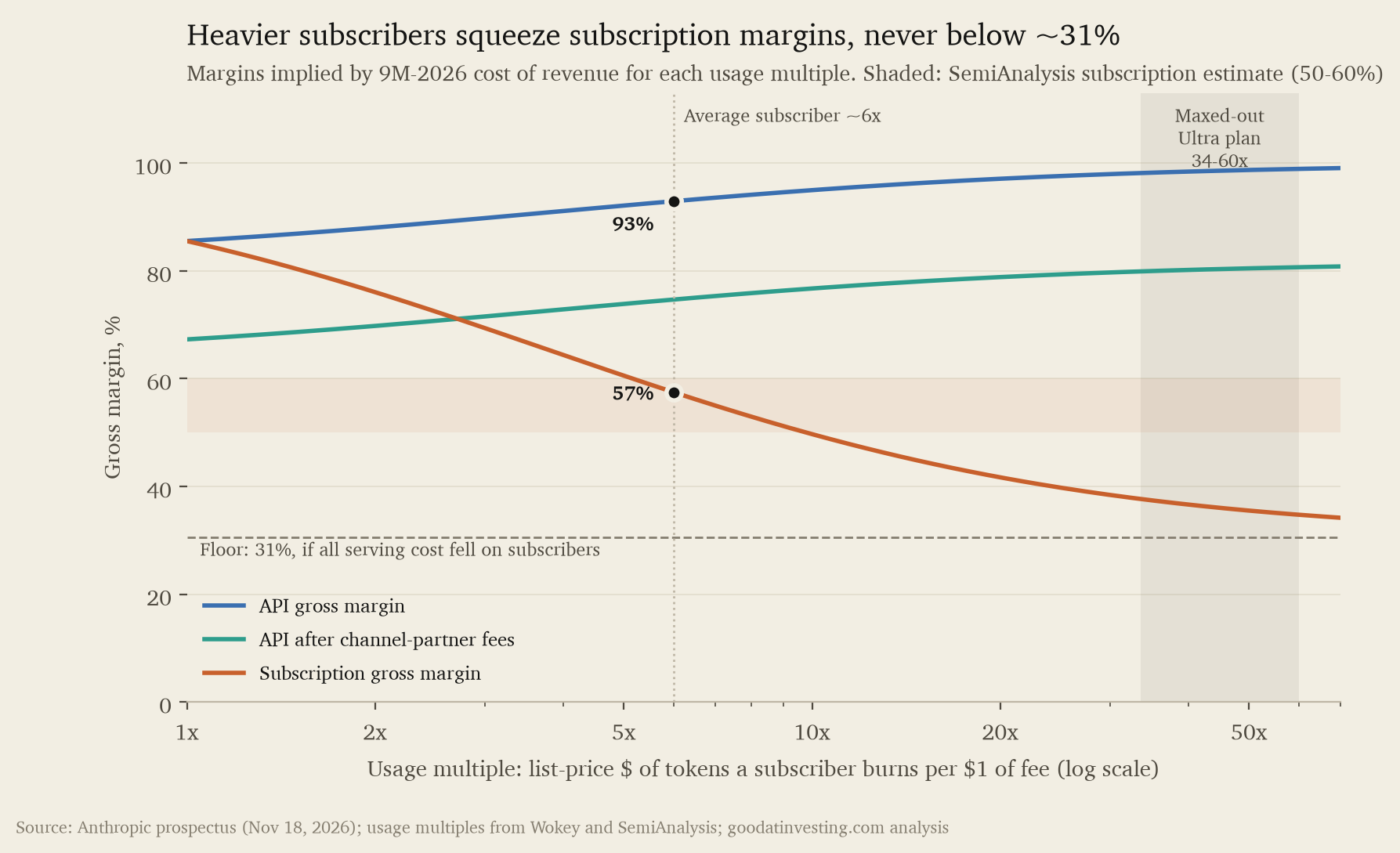
The floor first. Take the most pessimistic split possible: every cent of that $4.8B went to serving subscribers and API tokens were free. Subscriptions would still keep ($6.9B − $4.8B) ÷ $6.9B = ~31% gross margin. That's the worst case, and it can't be reached (API tokens aren't free), so the real number is higher. No outside data needed.
Then the split. The unknown is the usage multiple: if a subscriber paid API list prices for everything they used, how many times their subscription fee would that come to? SemiAnalysis supplied the two inputs. They metered a maxed-out $200 plan at ~$12,000 of Opus tokens at API prices (60x), and, from leaked financials, found the average subscriber uses ~10% of their cap. 10% × $12,000 ÷ $200 = ~6x.
Now assume every token costs Anthropic the same fraction of its list price, whoever's using it. At 6x, Anthropic served $26.3B + 6 × $6.9B = ~$68B of tokens at list price, for $4.8B. That's ~7¢ of cost per list-price dollar. So:
- API: pays full list, costs 7¢ per dollar → ~93% gross margin (~75% after Bedrock and Vertex take their cut).
- Subscriptions: each $1 of fee burns $6 of list-price tokens, at 7¢ each → 43¢ of cost → ~57% gross margin.
Heavier subscribers don't change the total cost; they just move it. If the average subscriber burned 60x, each token would have to be cheaper (the $4.8B is fixed) and subscriptions would drop to ~35%, sliding toward the 31% floor but never through it.
SemiAnalysis's own estimate: over 90% on the API, 50–60% on subscriptions. Same place. One honest asterisk: we borrowed their usage numbers, so this isn't two fully independent estimates. What's independent is the cost side: ours comes straight out of the S-1's cost of revenue, and it lands where they did.
In real tokens, that 7¢ per list-price dollar is roughly $1.40 per million Opus 5.5 output tokens that list at $20. A maxed-out Ultra plan would cost ~$480 a month to serve against its $200 fee; the average subscriber costs ~$85. Subscriptions are a gym membership, not a loss leader. The guy who lives at the squat rack is paid for by the twelve people who signed up in January.
Now the catch, and the reason an 85% gross margin doesn't make this a 50%-margin business. Gross profit ($28.4B) already covers R&D ($19.2B), but R&D grew 5.4x in a year, because each frontier model is replaced within months and the 25–40% cost-per-task gains get passed on to customers. Training isn't a fixed cost you spread over more tokens. It's a treadmill that speeds up with revenue, and you can't get off. In my model that's why the 85% gross margin becomes only a ~10% owner FCF margin by 2040.
(Caveat: cost of revenue is management's allocation of one shared compute pool, and the usage multiples are outside estimates.)
The $895B elephant
The S-1 lists $895B of compute commitments. That's about 14 years of today's revenue, with ~$448B due before 2031. Imagine signing a lease worth 14 years of your salary because you're confident about the raises. It's mostly rent, not capex: ~$437B sits in four take-or-pay deals, meaning Anthropic pays whether it uses the capacity or not.
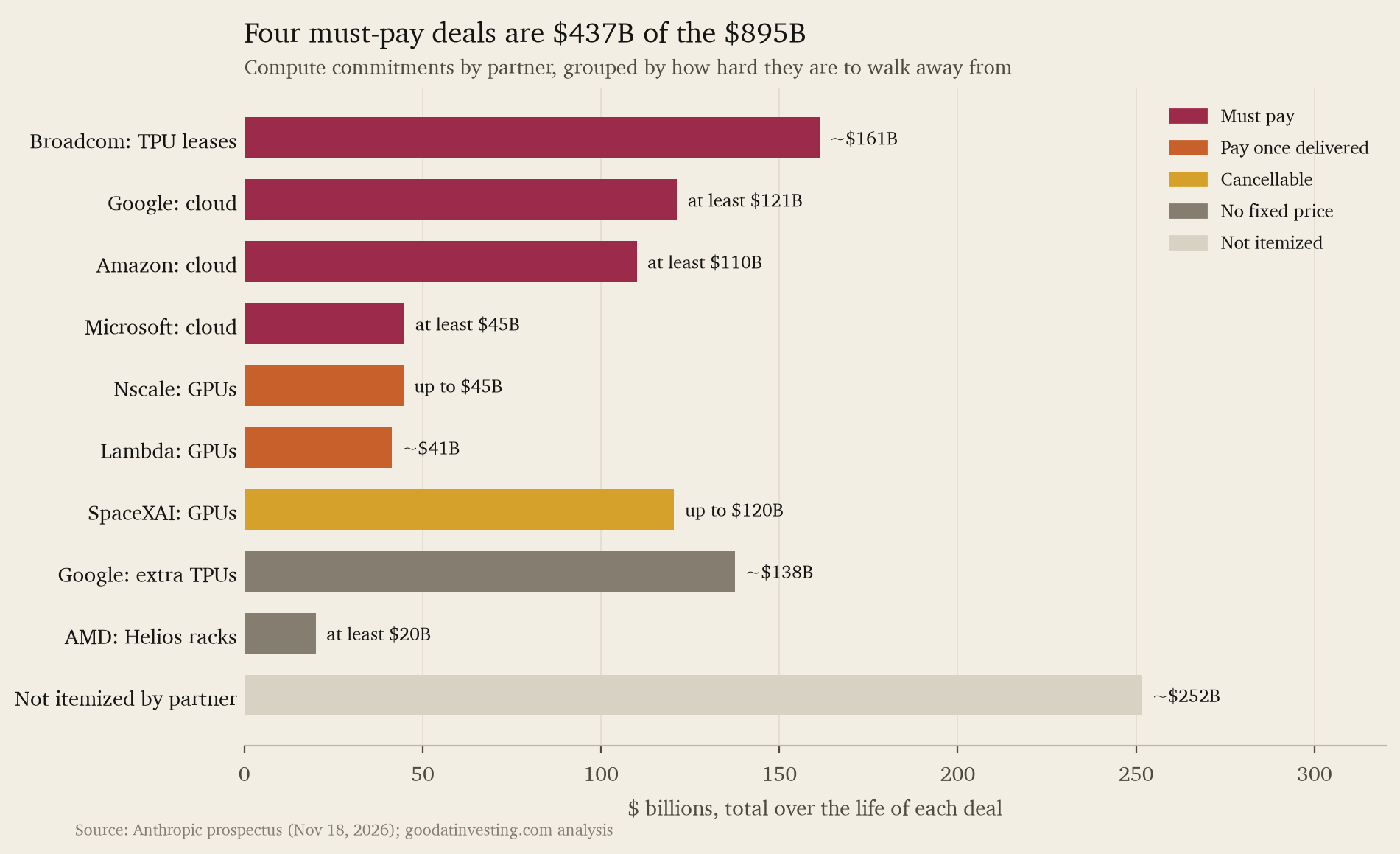
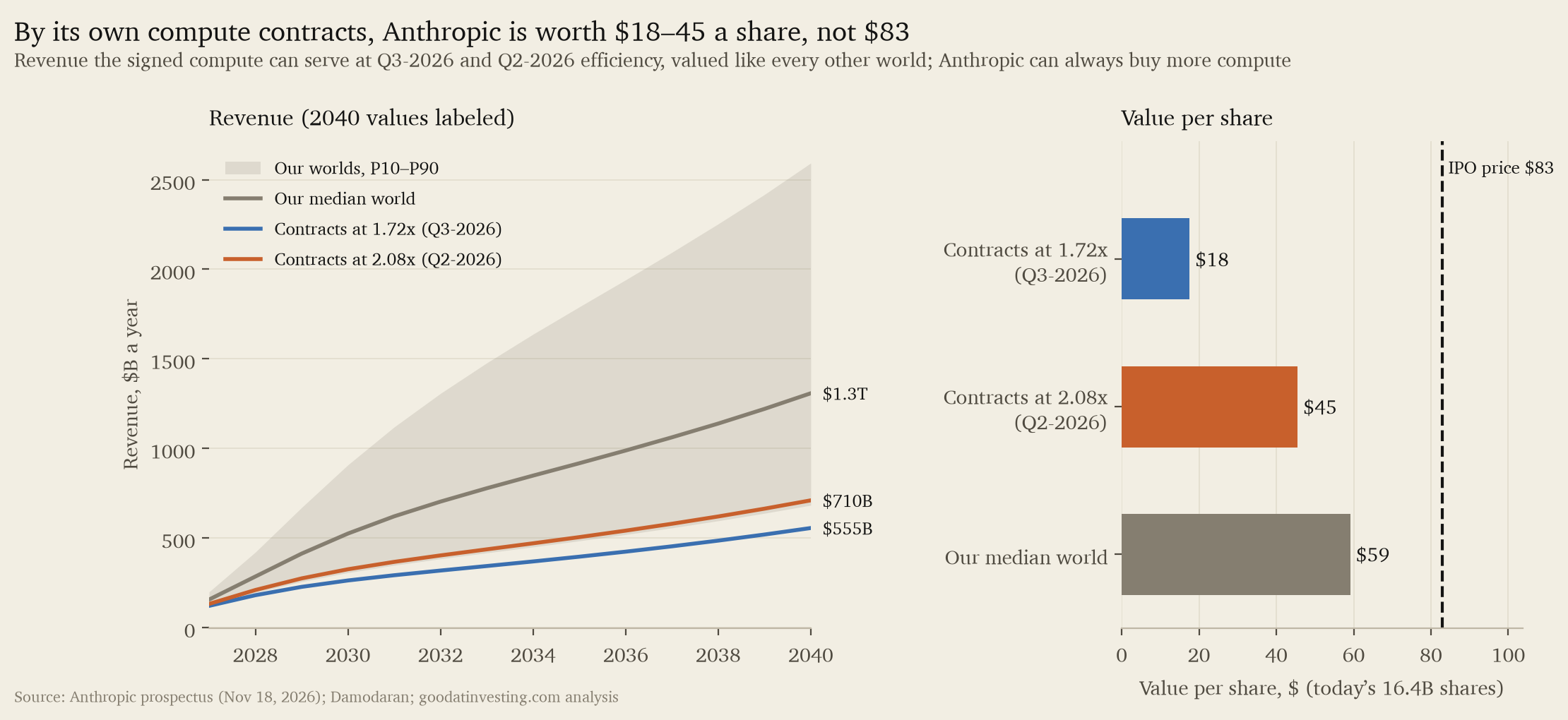
Here's the useful way to read it. Nobody signs for $895B of compute unless they think they can sell what it produces. So the contracts are a revealed forecast: not what management says, what management paid for. At Q3's efficiency ($1.72 of revenue per compute dollar), the signed capacity supports a revenue ceiling of ~$236B a year. At Q2's better efficiency (2.08x), it can serve ~$325B of revenue in 2030; at Q3's, ~$262B.
Value that revenue on the same rules as everything else in this post and you get ~$18–45 a share. That's my first anchor, the contracts view. It's a floor on the plan, not a cap: more compute can always be bought (maybe), and Anthropic has signed ~$100B more since September 30. But it's the only forecast with the company's money behind it.
Sidebar: What chips does Anthropic use?
This is just because I wanted to know, it doesn't really affect valuation but helps to understand where and how Anthropic is spending their money.
Anthropic is chip-agnostic: about 15.6 GW contracted across four families. Google TPUs ~6 GW, AWS Trainium ~5 GW, NVIDIA ~2.6 GW from five landlords, AMD ~2 GW. About 3.5 GW is online at the end of 2026, ~14.9 GW by 2030.
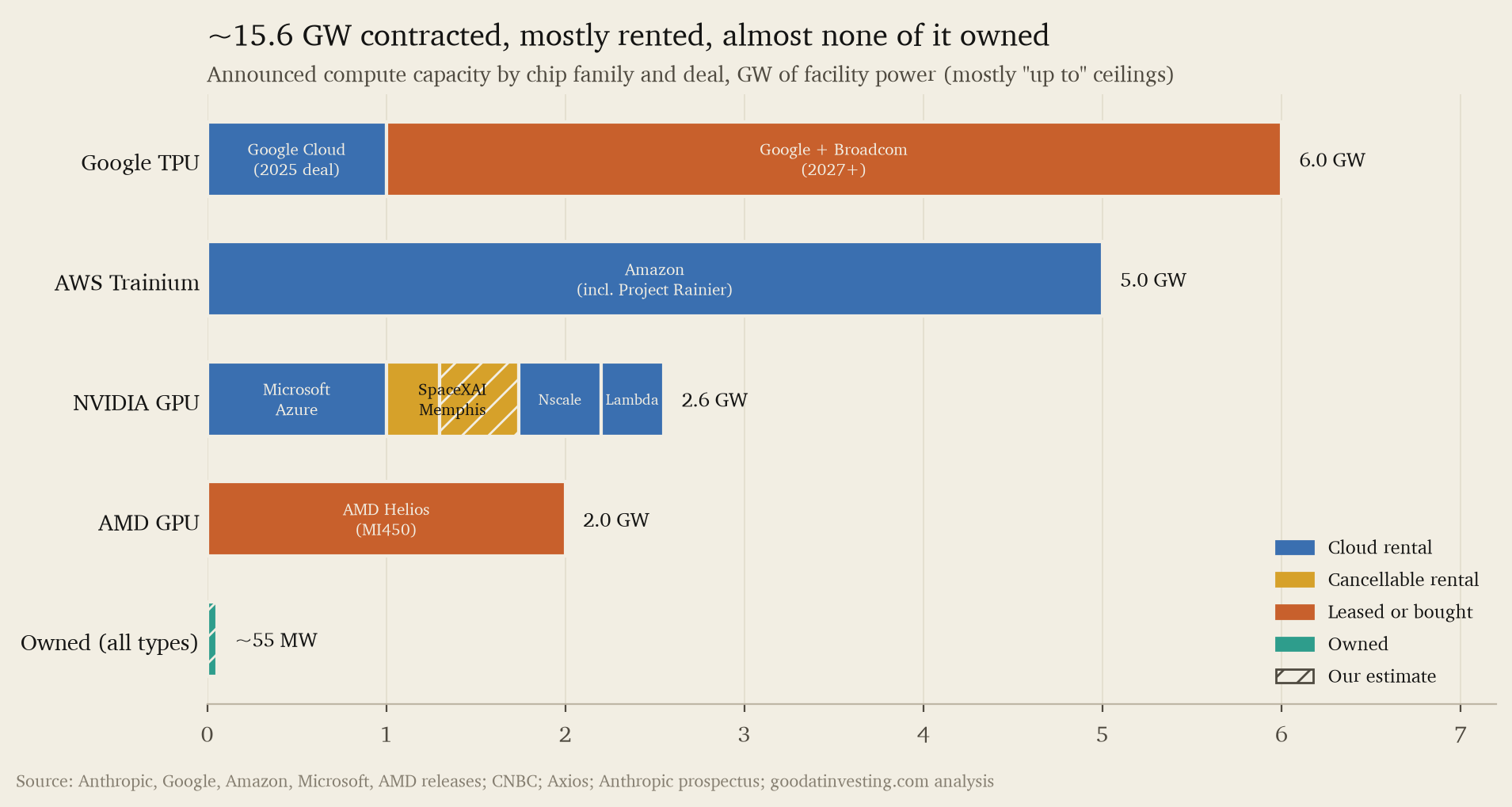
Anthropic owns almost none of it: ~55 MW of servers on the balance sheet, ~7 GW arriving from 2027 on finance leases (ownership on a payment plan), and the rest rented. And the rents vary a lot, the average rate for Anthropic is about $13M per MW year.
- SpaceXAI's Memphis data centers (Colossus 1 and 2): ~$50M. The spot premium for NVIDIA capacity available now, ~4x Anthropic's blended ~$13M. The airport-hotel rate.
- Multi-year cloud (Google, Nscale, Lambda): ~$16–18M.
- Amazon and Microsoft: ~$3–8M, but as lower bounds (the S-1's dollar floor divided by the announced "up to" megawatts).
- Leased or bought chips (Broadcom TPUs, AMD): ~$4–11M before power and buildings.
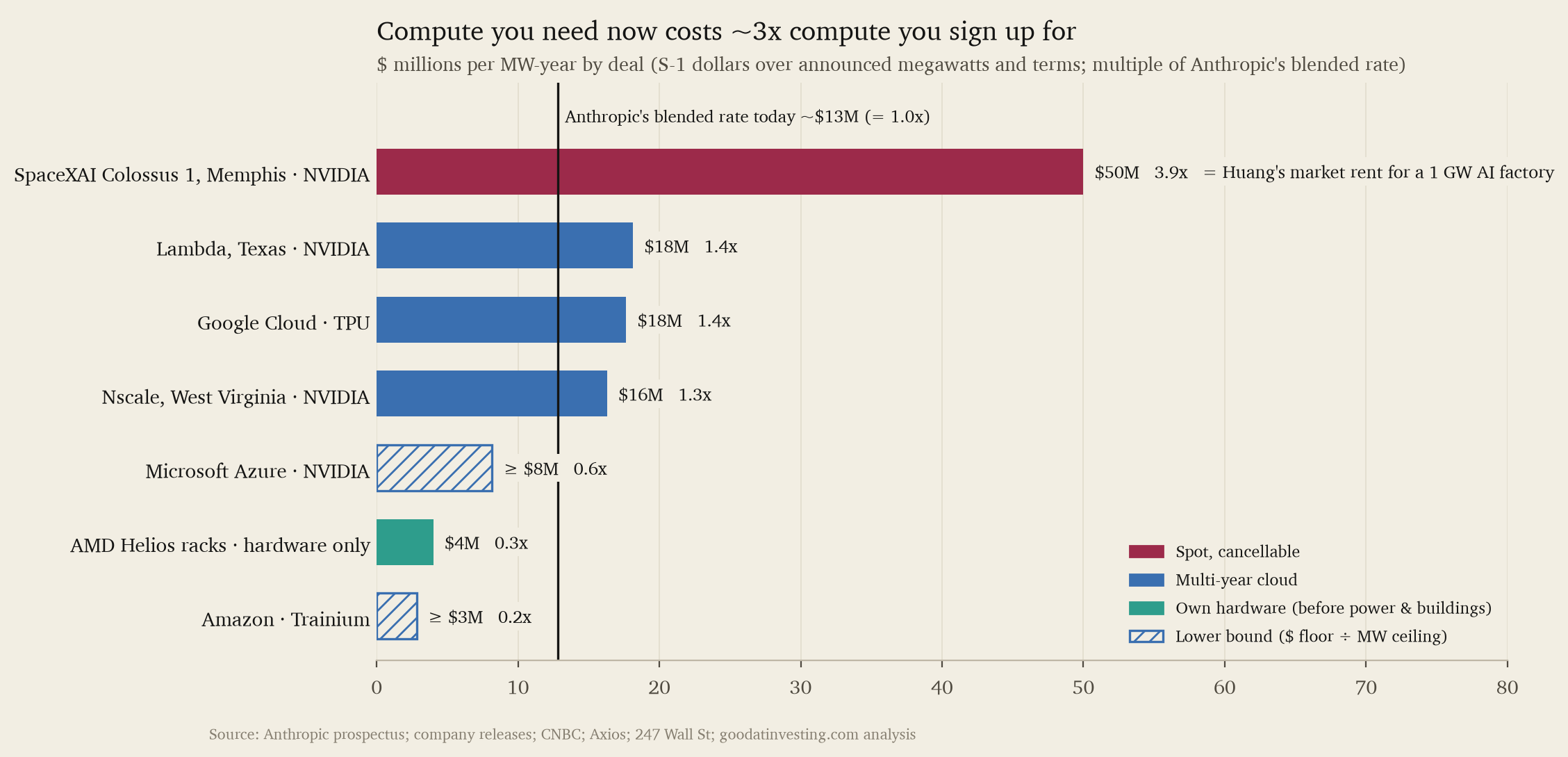
Read it as a scale, not contract prices. Moving off ~$50M spot capacity onto ~$4–11M leased chips is one of the few concrete ways Anthropic gets more revenue per compute dollar, and that efficiency turns out to be the number that matters most.
Forecasting the future, 20,000 times
The contracts give one answer. To get a second, I need my own forecast. The problem with a forecast is that it's one precise number that's guaranteed to be wrong. So instead of one, I made 20,000, and looked at the spread.
Step 1: pick a shape
Revenue grew 1,127% in a year. Keep that up and Anthropic out-earns the entire world economy by 2029. Something gives first, so I need a growth curve with a ceiling.
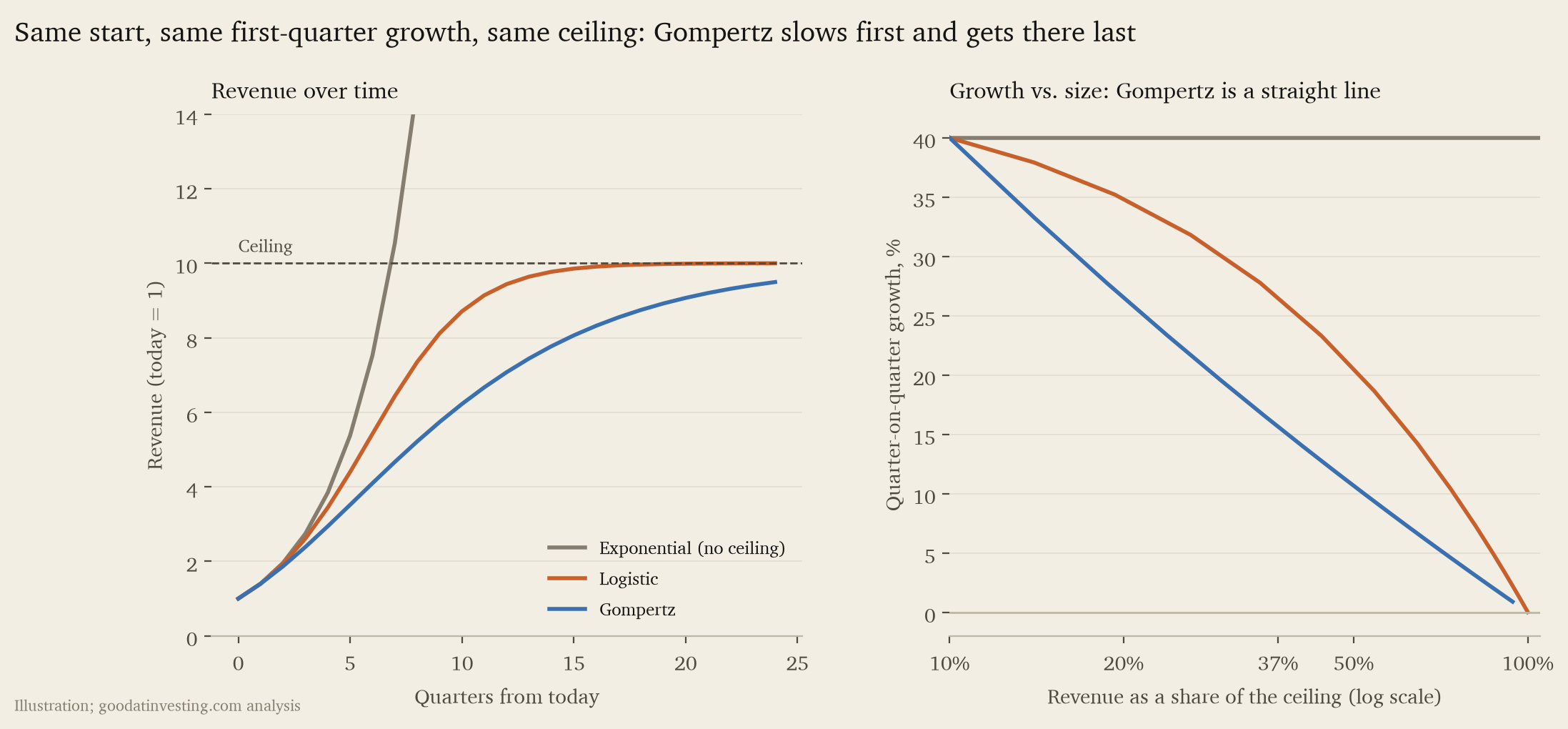
The two classics are the logistic curve (the familiar S-curve) and the Gompertz curve. Same start, same early growth, same ceiling, but Gompertz starts slowing down sooner and takes longer to get there. Its rule is simple: each quarter, revenue closes a fixed share of the remaining gap to the ceiling (measured on a log scale). Far from the ceiling, it grows fast. Close to it, it crawls. I picked it because it's the more cautious of the two. (Benjamin Gompertz invented it in 1825 for life-insurance mortality tables, which feels appropriate for a company whose models are retired every few months.)
Step 2: pick a ceiling
A curve with a ceiling needs a ceiling. Six quarters of data can't tell you where it is: fit it freely and you get ~$1.6 quintillion a year, roughly 15,000 world economies. So the ceiling comes from the S-1's own pitch, built from three numbers:
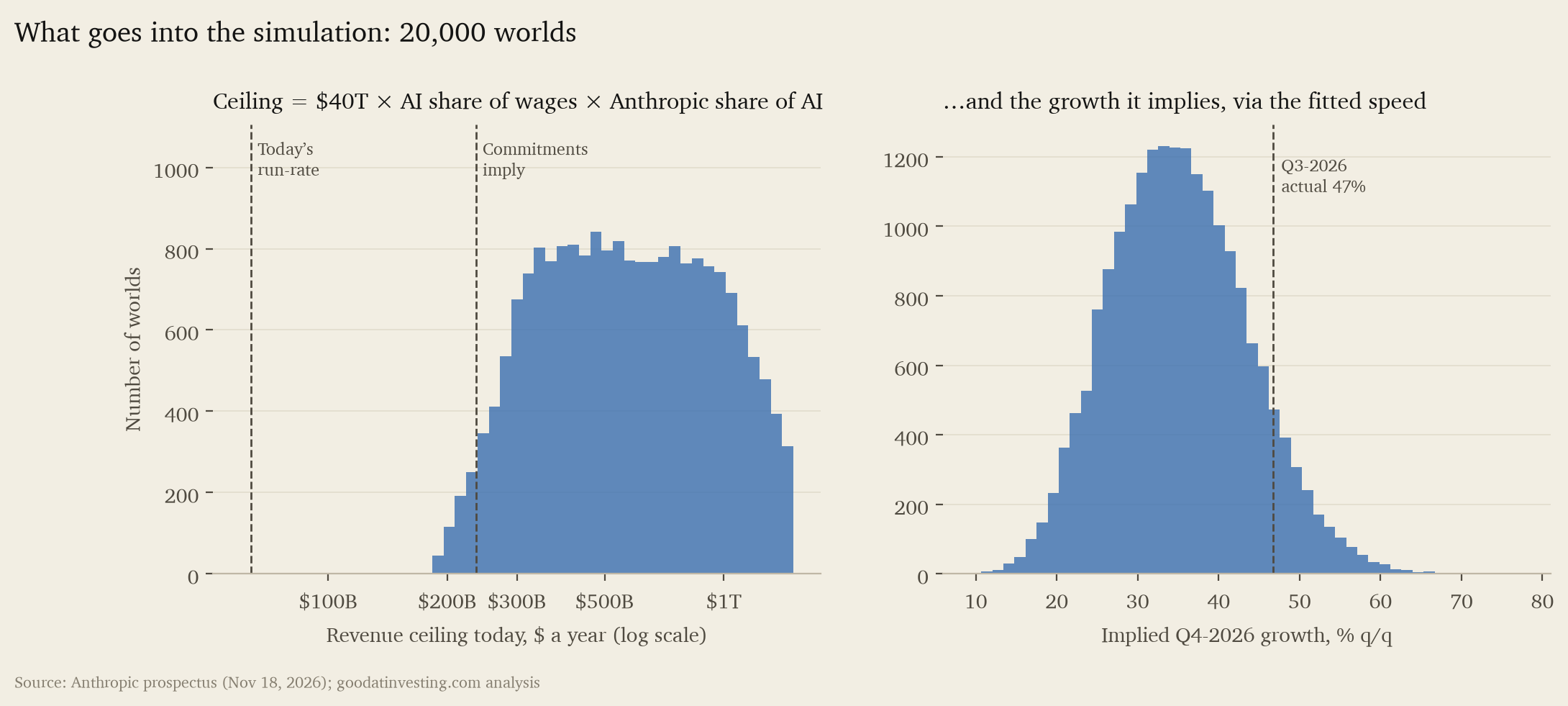
- $40T: what the world pays knowledge workers each year. That's the S-1's number for Anthropic's opportunity.
- AI's share of that, 1.5–8%: $0.6–3.2T a year spent on AI, about $50–270 a month per knowledge worker. For scale, cloud computing took 20 years to reach $1.9T, ~5% of $40T.
- Anthropic's share of AI, 30–55%.
Multiply them and the ceiling lands anywhere from ~$180B to ~$1.8T a year, ~$590B in the middle, about 9x today's run-rate. The six quarters of data then pick only the speed: how fast revenue closes the gap to whatever ceiling that world has.
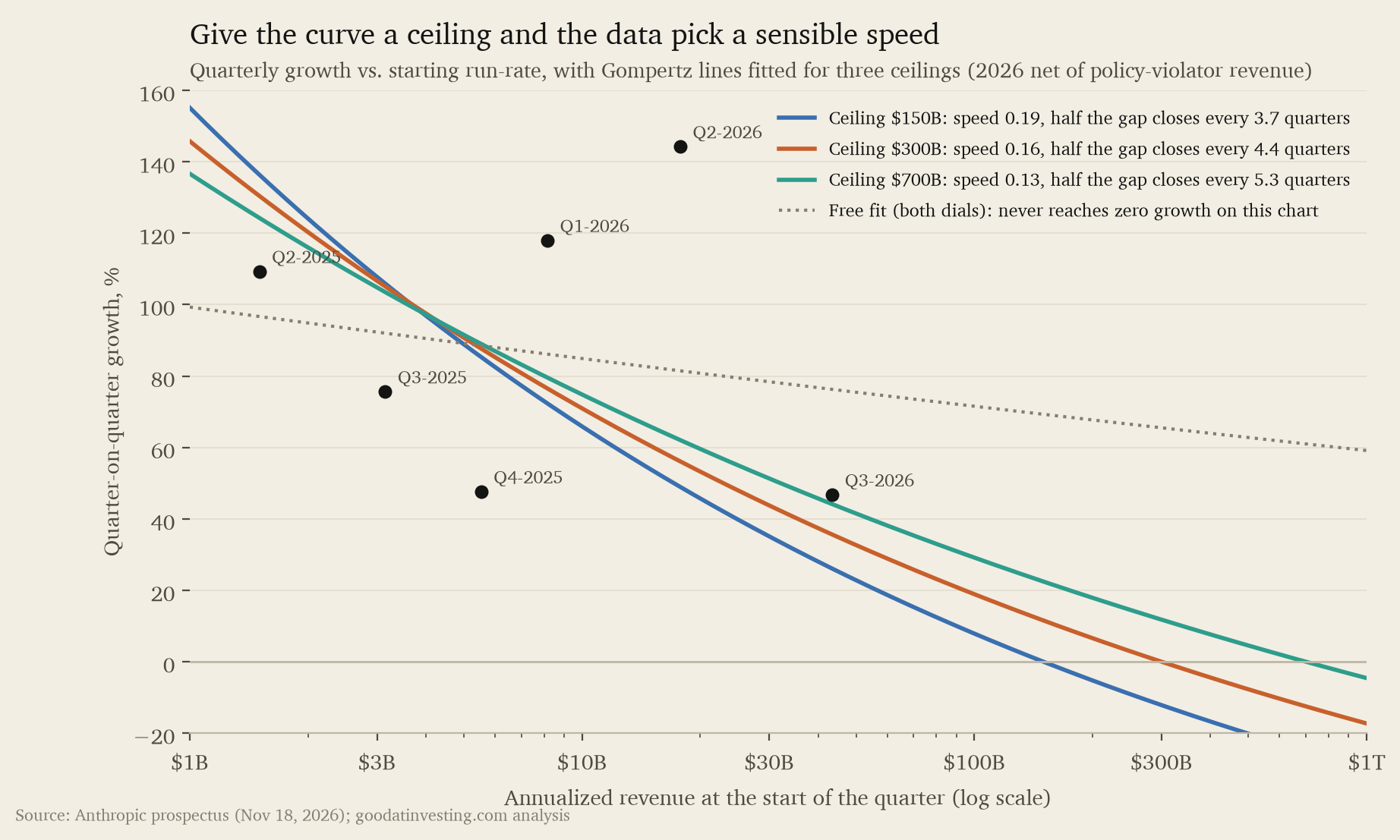
That 30–55% is my judgment based on personally putting hundreds of millions of tokens through many different models. Anthropic continues to be "that guy" and will command a pretty significant market share. It's also the assumption that moves the answer most: at 15–35%, the same model averages ~$44 a share, not $69. My estimate is higher than the contracts because they're only what Anthropic has paid for so far, not the most it can sell. It keeps signing, and in most of my simulated worlds it's short of compute, not short of customers. If you don't buy that, anchor on $18–45.
Step 3: pick an efficiency
The last unknown is how much revenue Anthropic squeezes out of each dollar of compute. Q2 was $2.08, Q3 $1.72. I let it land anywhere from $1.50 to $2.50: cheaper chips push it up, price cuts push it down. The compute bill is revenue divided by that number, and it can never fall below the take-or-pay contracts. Hold that thought.
Step 4: roll the dice
Those are the three dice: AI's share of wages, Anthropic's share of AI, and efficiency. Everything else is held fixed: cash operating costs at 25% of revenue, new stock grants 4%, donations 3%, owned equipment 4%, tax 21%.
Each roll makes one world:
- Roll the three dice. That gives a ceiling and an efficiency.
- Fit the speed so the curve matches the last six quarters of actual revenue.
- Run revenue out to 2040, subtract compute and every other cost, and get the cash left for owners each year.
- Turn that stream of cash into one number today (a DCF, explained below) and divide by 16.4B shares.
Do it 20,000 times.
The DCF, in one paragraph. A DCF (discounted cash flow) values a company as all the cash it will hand its owners, with cash further in the future worth less than cash today. How much less is set by the discount rate: here ~10.5% a year, the return you'd demand to own something this risky instead of a Treasury bond. I get it the textbook way (CAPM): the risk-free rate (4.94%) plus Anthropic's sensitivity to the market (a beta of 1.25, borrowed from listed software companies, since Anthropic has no trading history) times the extra return investors want for owning stocks at all (4.41%). Each world runs year by year to 2040, then grows at 3% forever.
What comes out
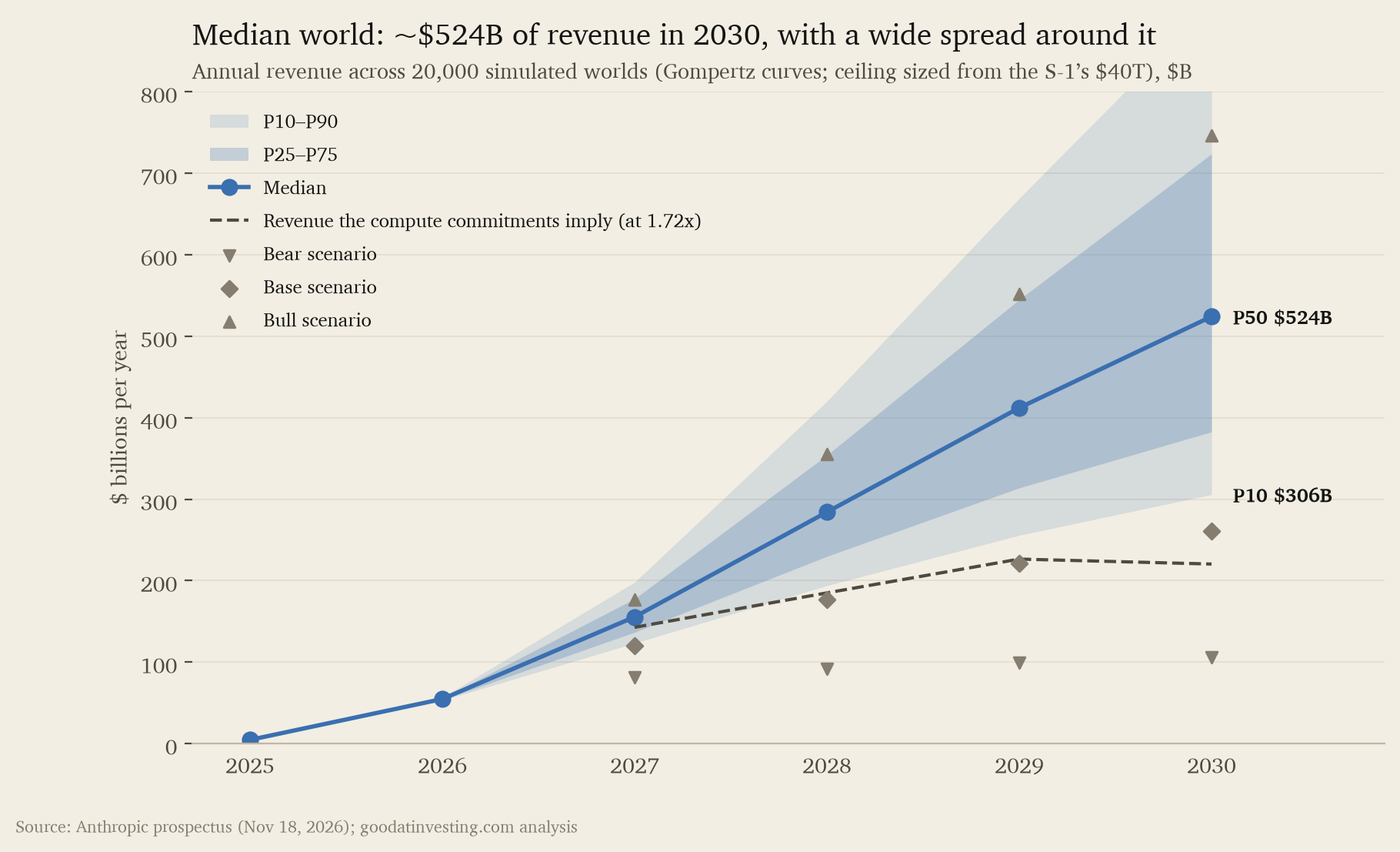
Median revenue is ~$155B in 2027 and ~$524B in 2030; the middle 80% of worlds land between $306B and $907B in 2030. Median real operating margin goes +5% / +13% / +18% in 2027/28/30. No world runs out of cash by 2030.
The interesting failure mode isn't staying small. It's being inefficient. Below ~$1.56 of revenue per compute dollar (Q3 was $1.72), every extra dollar of revenue loses cash once Anthropic outgrows its contracts, so growing makes it worse. About 4% of worlds end up worth $0 that way: if Anthropic can't keep getting more efficient, it grows itself into bankruptcy. That's the pile at $0 in the chart at the top of this post.
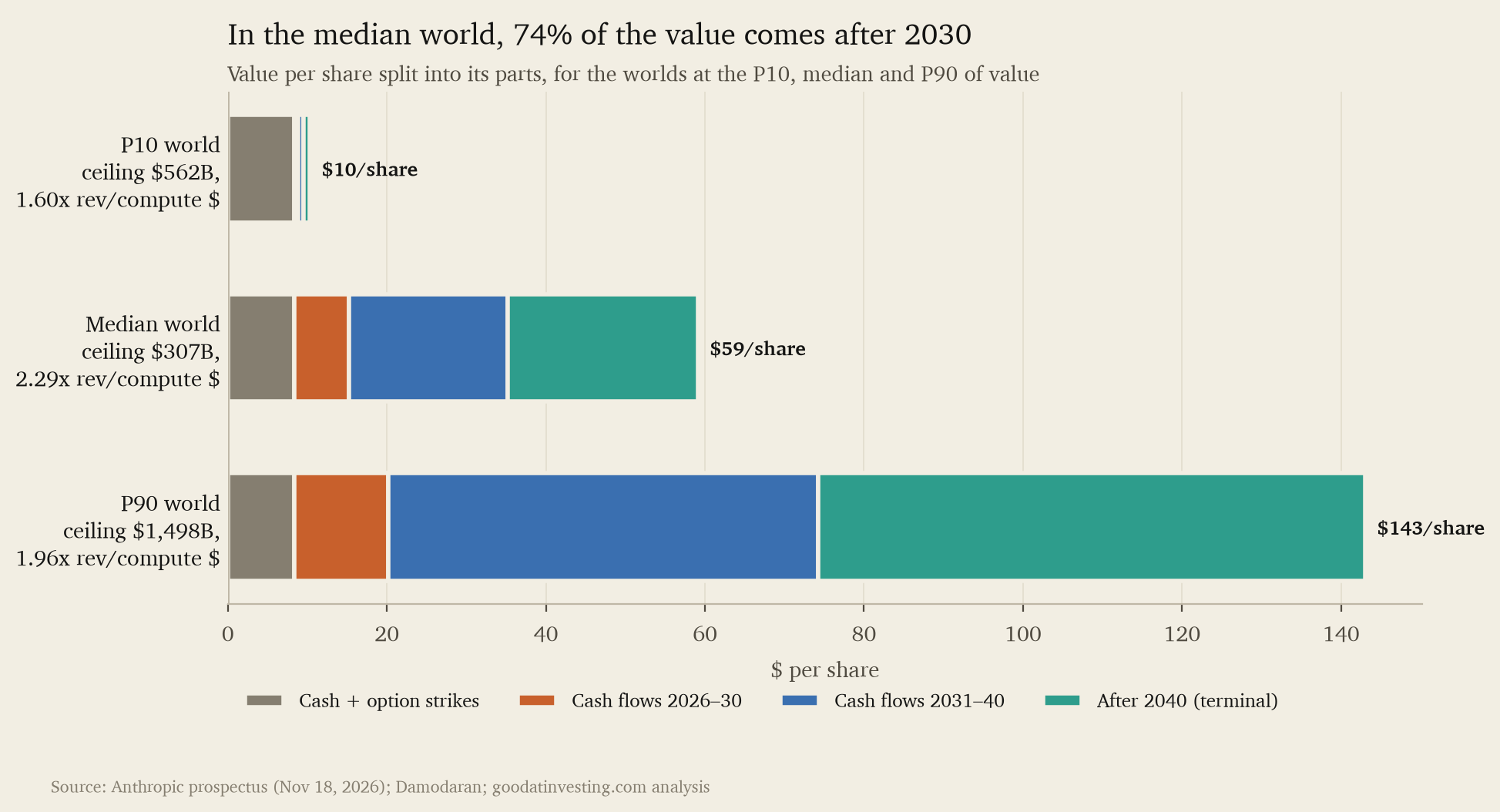
Now look at that chart again. Each bar counts how many of the 20,000 worlds landed at that value per share. A pile at zero, a broad lump from about $30 to $70, and a long tail of very good worlds (the last bar collects everything above ~$150).
The result: average ~$69 a share, median ~$59 (~$970B), and the middle 80% of worlds land between $10 and $143. The average sits above the median because a few huge worlds drag it up, the way one billionaire walking into a bar raises the average net worth but not the median. I headline the average because a fair price should pay for those worlds too.
Put every price on one ladder:
| $/share | |
|---|---|
| Series G round | $25.91 |
| Contracts view | $18–45 |
| Series H round | $58.90 |
| My median world | ~$59 |
| My average | ~$69 |
| Anthropic's own Sep-30 mark (implied by the Amazon notes) | ~$71 |
| Marketed range | $70–78 |
| IPO price | $83 |
Seven weeks before pricing, Anthropic's own books valued a share at about $71.
Two more things fall out. First, 74% of the value arrives after 2030, so you're mostly buying the 2030s. Second, remember the efficiency dial: it matters more than the ceiling. With a mid-sized ceiling, going from low to high efficiency takes a share from ~$23 to ~$99. Run the whole thing backwards and buying at $83 into the median world earns ~8.3% a year, against the 10.5% the risk demands.
Build your own. Every one of those dice is my opinion, and you probably have different ones. So I built a playground with a slider for each input: set your own share of AI, efficiency, costs and discount rate, and watch the 20,000 worlds (and the value per share) move.
Your slice of the pie
Anthropic pays its people in stock and gives stock away to charity. Both come out of your slice.
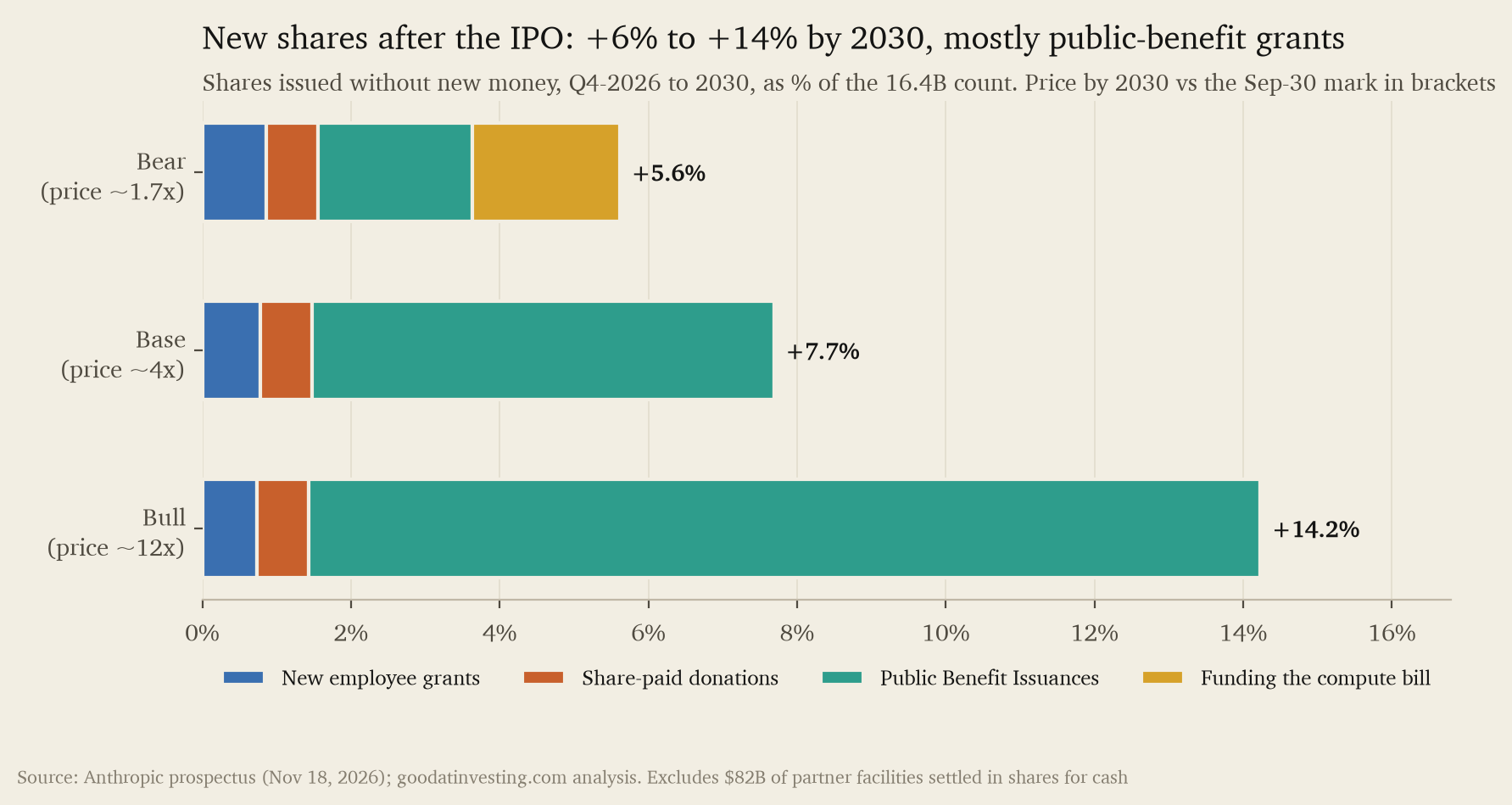
Stock comp and donations were ~16% of revenue in 9M-2026 ($3.3B + $2.1B). An $8.2B stock-comp charge hits the day the IPO lands, and there's a $32.3B backlog of RSUs already granted. Stock comp roughly triples after the IPO. Congratulations to everyone at Anthropic; please don't all sell on the same day.
How the valuation handles it:
- Grants already made are in the 16.4B shares. Not charged twice.
- New grants (4% of revenue) and donations (3%) are charged as costs every year, forever. Against a ~10% owner FCF margin, that's roughly 40% of what owners would otherwise keep.
- In dollars: they take ~$36 a share. Without them the average world is worth ~$105; with them, $69. That's what the company's "Adjusted" add-backs are actually worth to you as an owner: about a third of the company.
- The Public Benefit Fund's top-ups (up to 2% more shares each time the price rises 50% from $83) cost only ~1% on average. A world has to be worth $125+ to trigger one. They trim the best outcomes (90th percentile $143 → $140), not the middle.
The fair point: none of this is hidden. The Public Benefit structure and the donations are disclosed, deliberate and part of why Anthropic exists in this form. You're buying a company that has pre-committed some of its upside to the public. Price it, don't moralize about it.
Footnote: the prospectus also counts a 553M-share "Vested Matching Obligation" (~16.9B shares pre-IPO) for donations employees have pledged. I charge it as part of the donations cost instead of counting it twice. Count it as shares and the average is ~$67.
What $83 needs without a miracle
On my forecast, not much. Starting from a ~$69 world and turning one dial at a time, $83 needs any one of: a ~$730B revenue ceiling, or $2.12 of revenue per compute dollar (Q2 did $2.08, Q3 $1.72), or other costs falling to ~21% of revenue by 2040 instead of 25%, or a ~9.3% discount rate. None of those is crazy. Q2 nearly did the efficiency one already.
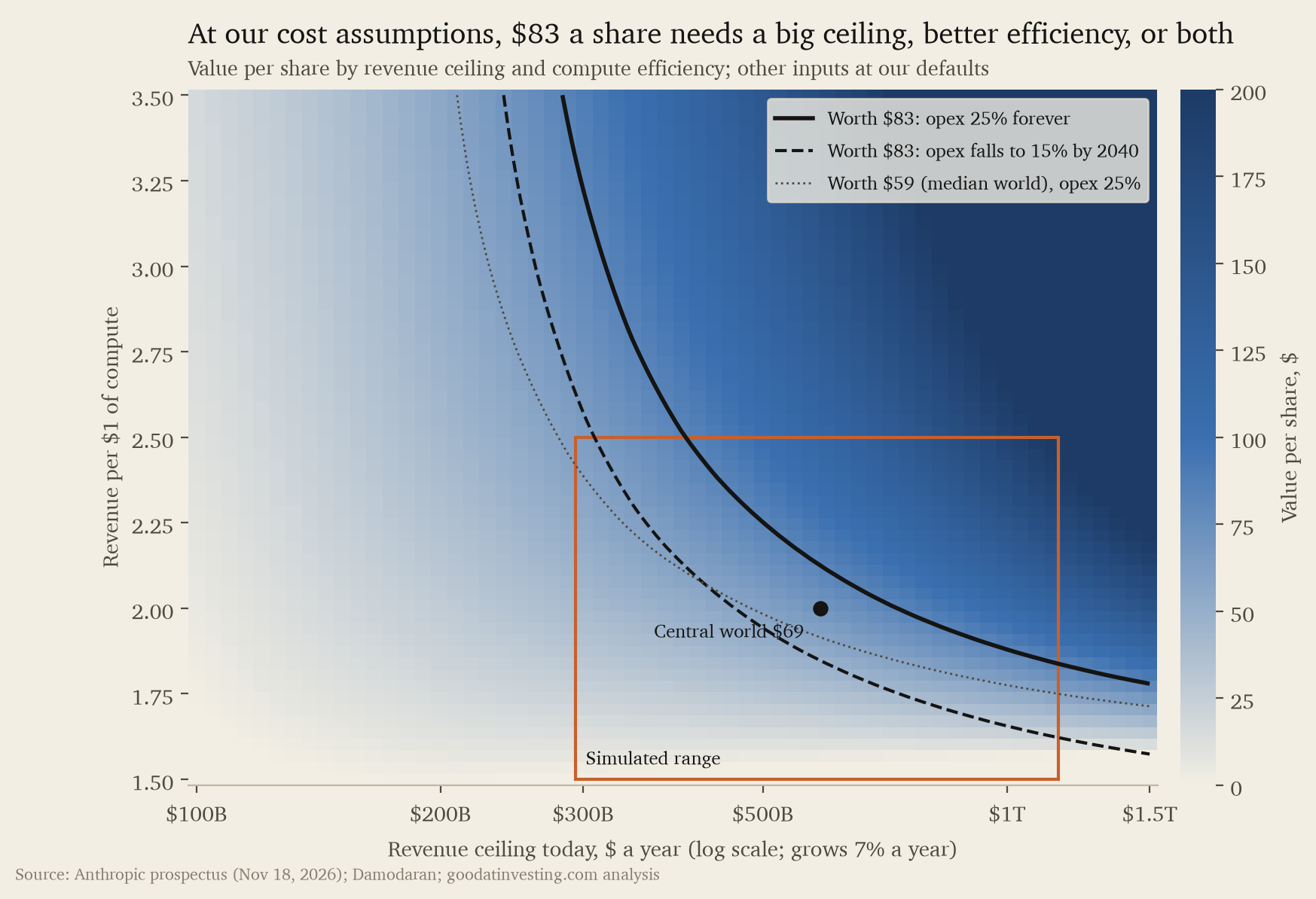
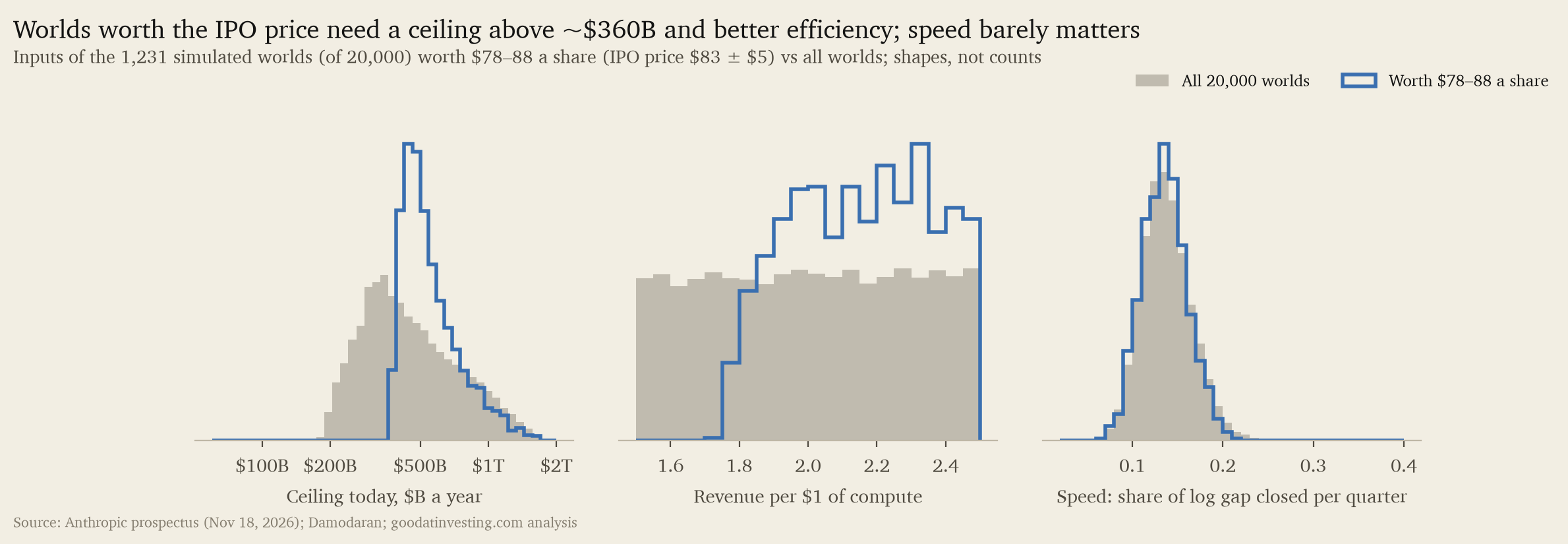
Or ask the simulation directly: which worlds are worth about $83? They're the ones with a ceiling above ~$360B and efficiency above ~$1.80. How fast revenue grows barely matters. How big and how efficient it gets is everything. If Anthropic doesn't grow in market share, but AI ends up being a big thing (it will) and efficiency is gained to a level they've already proved, that valuation is more than justified.
On the contracts view, it's a different story: $83 is ~2–5x the $18–45.
Either way, an IPO buyer is paying for the better third of my worlds, or for more business than the company has contracted for. So what else could they be paying for?
The lottery ticket
Split the price into two parts: the business, which a DCF can value, and whatever's left over. On my forecast, the business is $1.14T ($69 a share) and $0.22T is unexplained: the DCF covers ~84% of the price. On the contracts view, the business is $0.29–0.74T and $0.61–1.07T is unexplained.
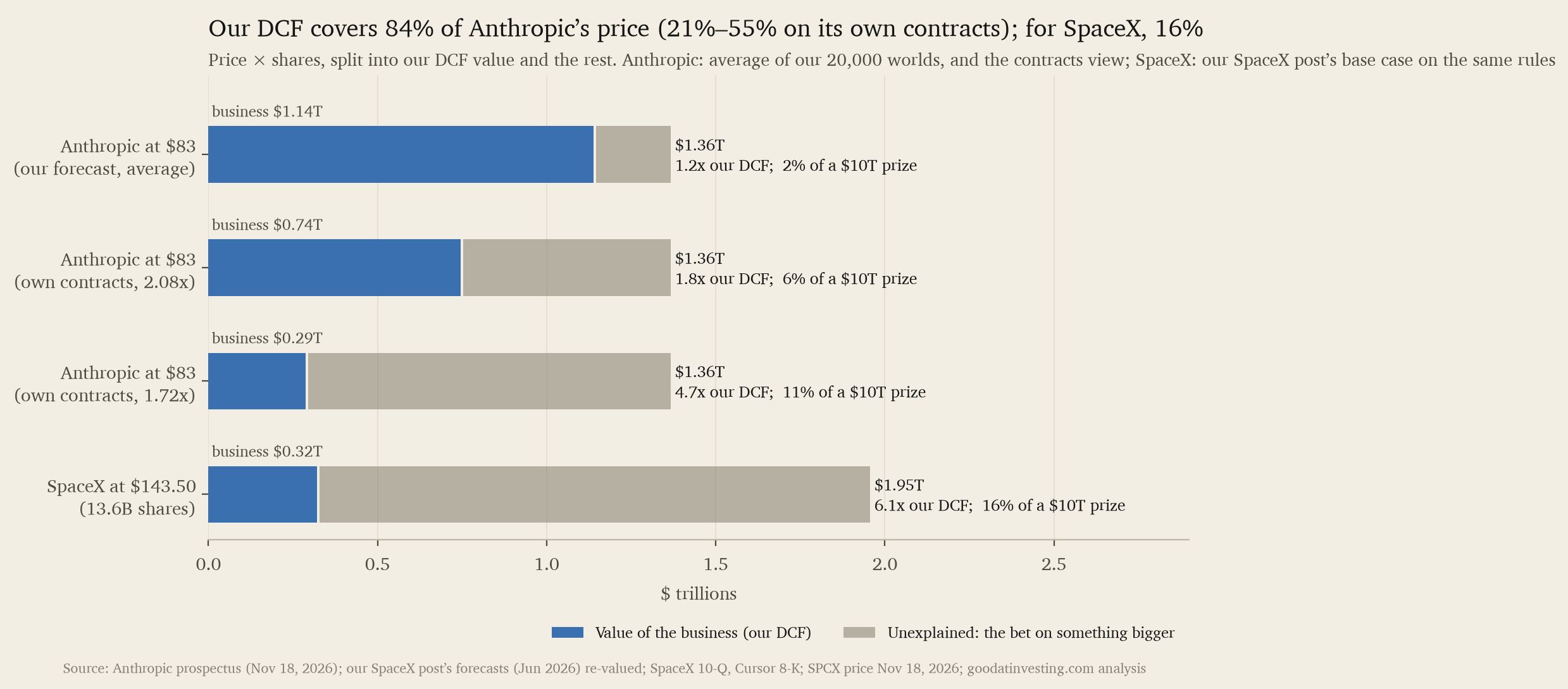
We know effective altruists love some Bayesian priors, so we can use probabilities to find the reasons for the hole in the valuation. This is the same trick as the SpaceX post: call the leftover a lottery ticket on a $10T payday, and the ticket price divided by the jackpot is the odds the market is paying for. $0.22T ÷ $10T means $83 prices a ~2% chance that Anthropic wins it on my forecast, ~6–11% on the contracts view.
What could a $10T payday be? (Scenarios, not forecasts. $10T is a round number I picked to put a size on the moonshot.)
- Usable AGI. The same $40T of knowledge work, except Anthropic takes a large share of it, not 1.5–8%.
- Drug discovery, a cancer cure. Does internal drug discovery find some huge cure? They're at least trying this.
- A room-temperature superconductor or some other new material. Remember the Korean superconductor? Fun times on twitter.
- Something weirder. A company with its own fleet of superhuman researchers doesn't have to license its discoveries. It can start the drug company itself.
How much to bet
In 1956 a Bell Labs scientist named John Kelly worked out how much a gambler with an edge should bet so their money grows fastest over time. The Kelly criterion answers the investor's version: given my odds, how much of my portfolio should this be? Bet too little and you leave money on the table; bet too much and one bad outcome wipes you out. Most people use half-Kelly, because nobody knows their odds as well as they think.
On my forecast: below ~2.2% belief in the prize, own none. At 5%, Kelly says ~11% of a portfolio (half-Kelly ~6%); at 10%, ~26%. Put another way, a 5% belief makes ~$100 a fair price, 10% makes ~$131. If the $10T arrives around 2035 (~$4T in today's money), you need ~5.5% before buying at all. On the contracts view, you need ~6–11% before owning a share.
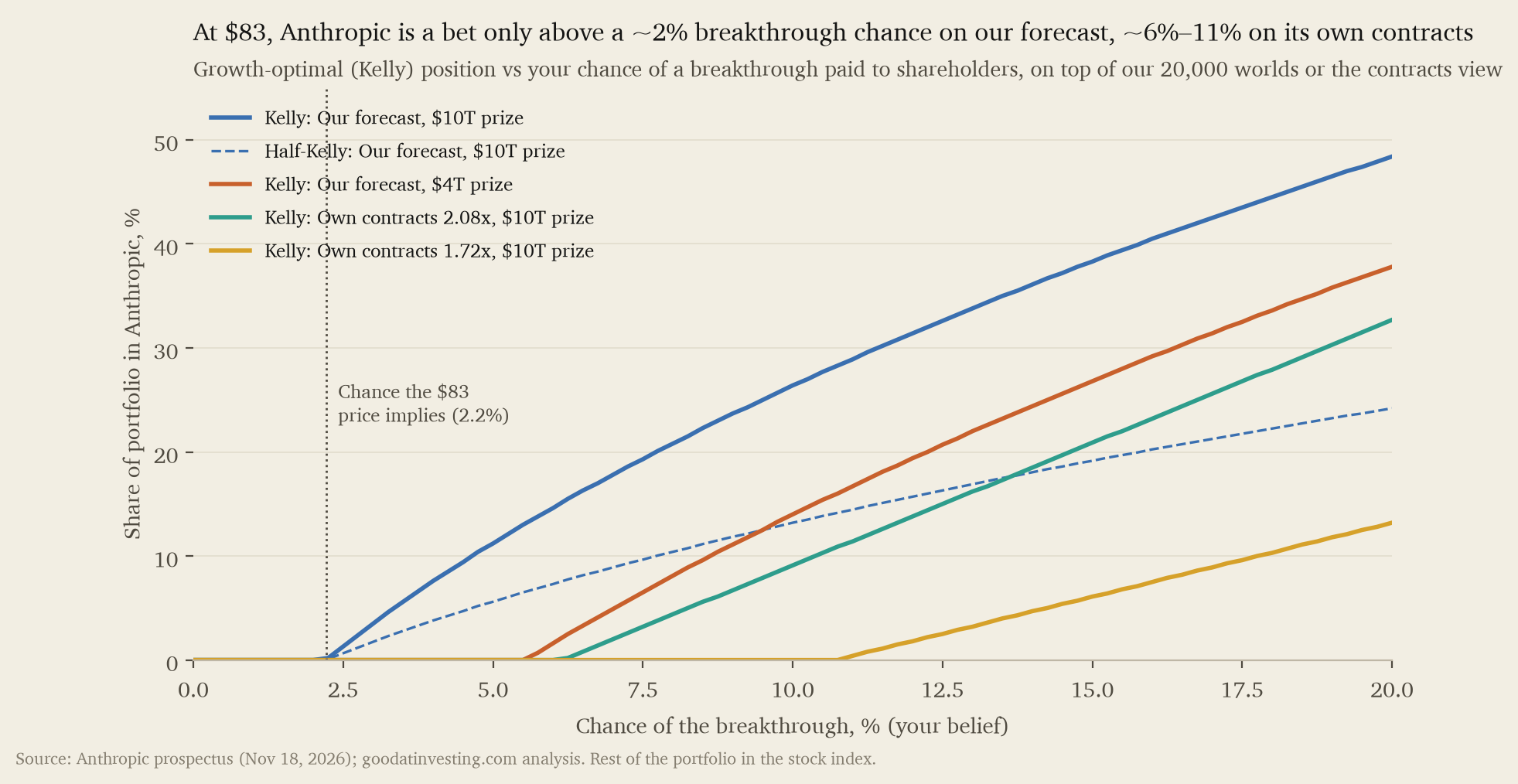
Kelly is brutal to overconfidence. Use it to see what your opinion implies, not to pretend you have one.
Versus SpaceX: more of its price rides on the moonshot, and it's less likely to land it
Despite landing rockets.
The numbers. Anthropic trades at 24x trailing revenue (35x on fully diluted shares); SpaceX at 59x. Anthropic grew 12.3x in a year; SpaceX 2.6x, mostly by buying xAI and Cursor, which is a growth strategy in the same way buying a gym membership is a fitness strategy. On the same basis (after interest and stock comp), Anthropic's trailing FCF is −$6.0B; SpaceX's is −$46B.
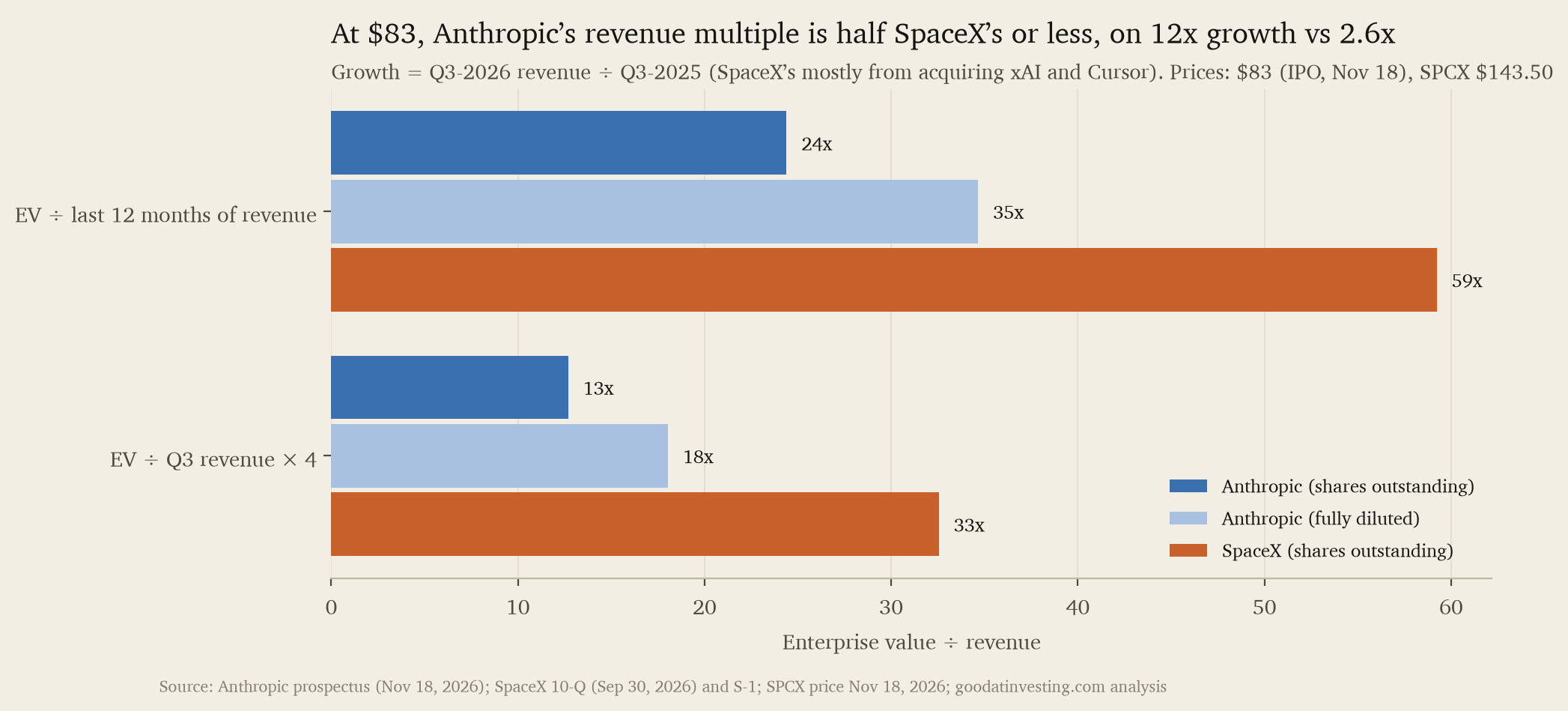
To compare fairly, I re-valued my SpaceX post's forecasts on this post's rules: today's balance sheet, Cursor at its $60B deal price, stock comp as a cost, and a CAPM rate. That doubles my SpaceX value to $23.64 a share. Being twice as generous doesn't get you far: at its Nov 18 close of $143.50 (the day Anthropic priced), SpaceX is still 6.1x that, $0.32T of business and $1.63T unexplained. Its price implies a ~16% chance of the $10T prize, 1.5–7x what Anthropic's price asks for, depending on the anchor. Even on my stingiest Anthropic anchor, SpaceX asks for more. (In the SpaceX post I got ~15.6% for xAI on a cruder method. The market hasn't changed its mind, and neither have I.)
The argument (mine, not the S-1's):
- SpaceX's other businesses are the explainable part. Starlink and launch have track records, so a DCF can value them, and mine does: they're inside the $23.64. That means SpaceX's $1.63T gap isn't mostly Starlink upside. It's the AI bet.
- A $10T breakthrough is the only plausible source of a gap that size, for either company.
- Anthropic is better placed to win it. SpaceX's AI arm mostly sells compute rather than its own model. Its Q3 10-Q shows one unnamed "Customer B" at 34.5% of SpaceX's revenue (~$5.0B), all in the AI segment: two-thirds of the segment's $7.56B. Everything else, Grok, Cursor, X subscriptions and X ads, comes to ~$10B a year, about a seventh of Anthropic's run-rate. Customer B being Anthropic is my inference (Anthropic pays SpaceXAI up to ~$3.1B a month), but the Memphis lease is not: up to $120.5B through 2029, at the ~$50M per MW-year from the sidebar, the most expensive capacity Anthropic buys. A landlord earns rent on the payday. The lab that builds it collects it.
- So the market asks for higher odds from the company worse placed to win. Most people in AI would rank Anthropic's chances above SpaceX's. That's an opinion, and I'm saying it's one. But if you think Grok is better than Anthropic, then I know everything I need to know about you.
The fair objections.
- My SpaceX forecasts are from June, and capex has run ~3x forecast since. If Starlink and launch are worth less than I credit, SpaceX's gap gets bigger, which helps the argument.
- Some of SpaceX's gap may be enthusiasm or a lower discount rate, not an AI bet. Enthusiasm is not a rounding error when the company owns its own social network.
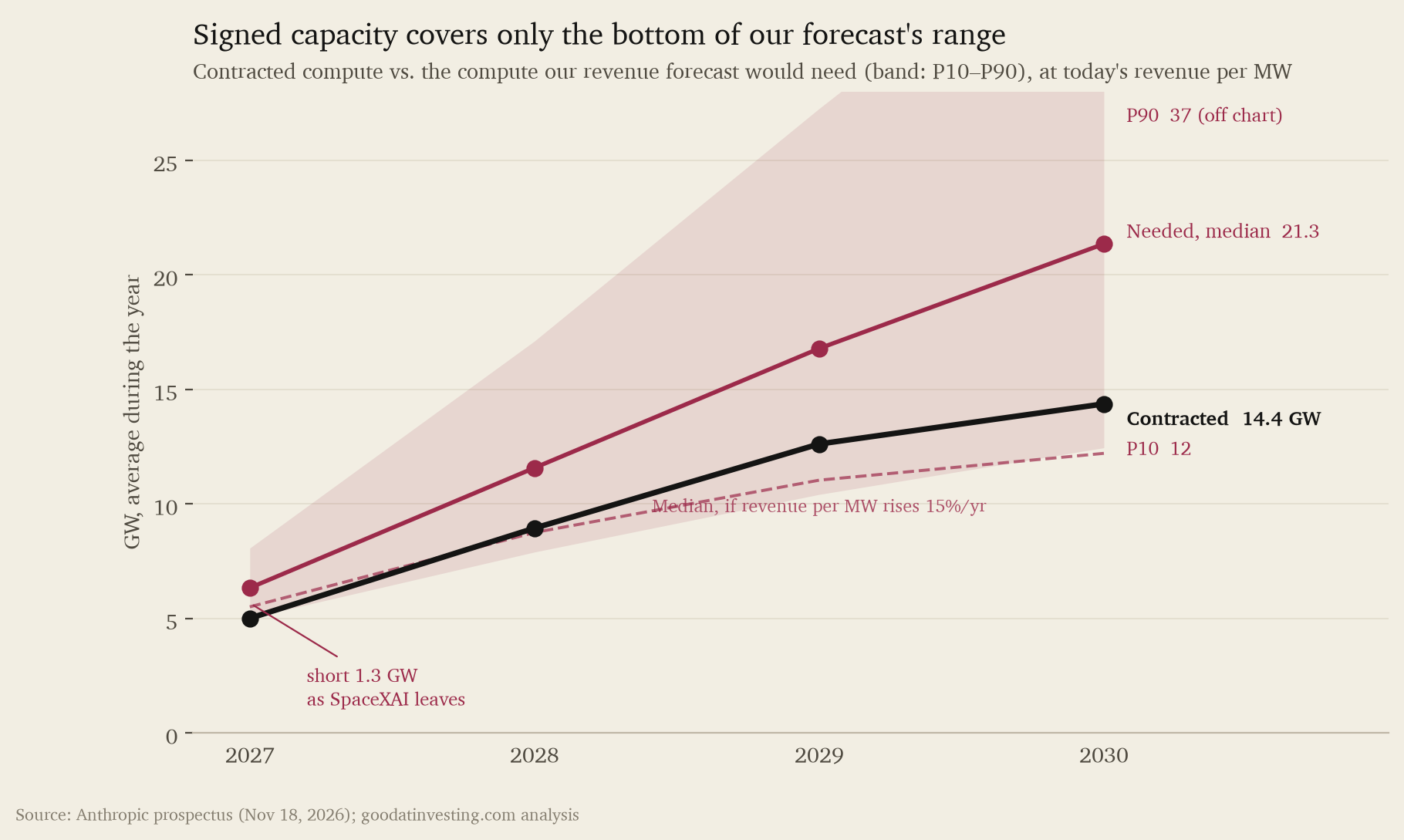
- The payday needs compute, and Anthropic is short of it exactly in the worlds where it wins. Signed capacity is ~1.3 GW short of my median path in 2027 and ~7 GW short by 2030 (21 GW needed, 14 signed). The 90th-percentile world needs ~37 GW, 2.6x what's signed. Only my bottom decile fits inside the contracts. SpaceX owns its data centers. My answer: SpaceX is renting those data centers to Anthropic, and capacity can be bought; a frontier model can't. (Analyst notes say Anthropic won't extend the Memphis leases past mid-2027. Unconfirmed.)
Verdict
$83 is ~2–5x what Anthropic's own contracts support ($18–45) and 1.2x my more generous forecast ($69). The rest is either a top-third business outcome or a ~2% (forecast) to ~6–11% (contracts) ticket on a $10T breakthrough.
Not a buy call. But next to SpaceX, it's the more fairly priced trillion-dollar IPO, and the part of its price I can't explain rests on the moonshot it's better placed to win. If you have an opinion on those odds, Kelly tells you how big a position that opinion supports. If you don't, the contracts say $18–45. If you think my dice are wrong, the playground is right there.
Caveats. Anthropic's share of AI spending drives everything (15–35% gives $44; 30–55% gives $69). The beta is borrowed from peers. Prices are Nov 18 for both companies, and the day-one open moves the odds. The share count leaves out the 553M-share matching obligation (charged as donations instead). The numbers are in the repo if you want to check my work, or find the breakthrough I missed.